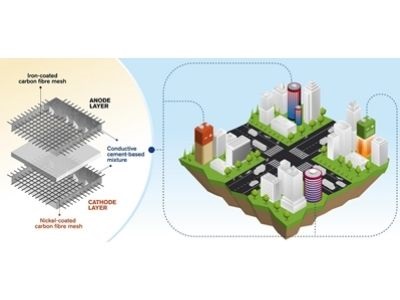
Imagine an entire 20-story concrete building that can store energy like a giant battery. Thanks to unique research from Emma Zhang and Luping Tang such a vision could someday be a reality. Together, they have succeeded in developing the world’s first concept for a rechargeable cement-based battery.
In their study, the researchers produced a rechargeable cement-based battery with an average energy density of 7 Watthours per square meter. Energy density is used to express the capacity of the battery, and a modest estimate is that the performance of the new battery could be more than 10 times that of earlier attempts at concrete batteries. The energy density is still low in comparison to commercial batteries, but this limitation could be overcome thanks to the huge volume at which the battery can be constructed when used in buildings. The study was published in the journal Buildings.
“We have a vision that in the future this technology could allow for whole sections of multi-story buildings made of functional concrete. Considering that any concrete surface could have a layer of this electrode embedded, we are talking about enormous volumes of functional concrete,” said Zhang. "Since concrete infrastructure is usually built to last fifty or even a hundred years, the batteries would need to be refined to match this, or to be easier to exchange and recycle when their service life is over. For now, this offers a major challenge from a technical point of view.”’
But, the researchers are hopeful that their innovation has a lot to offer. Concrete, which is formed by mixing cement with other ingredients, is the world's most used building material. From a sustainability perspective, it is far from ideal, but the potential to add functionality to it could offer a new dimension.
Photo: Researchers from the Department of Architecture and Civil Engineering recently published an article outlining a new concept for rechargeable batteries—made of cement. Credit: Yen Strandqvist/Chalmers University of Technology