Credit: Chulalongkorn University
Researchers at Chulalongkorn University in Thailand are studying giant viruses that prey on bacteria—nucleus-forming jumbophages—as a possible way to fight antibiotic-resistant infections in humans, as well as a disease that devastates shrimp farms. Their work has already produced a commercial phage cocktail for aquaculture.
Bacteriophages, or phages, are viruses that infect bacteria. They attach to a bacterial cell, inject their genetic material and take over the cell’s machinery to make new phages until the cell bursts. Jumbophages carry exceptionally large genomes, and the nucleus-forming kind build a protein shell around their DNA after infection, creating a compartment that resembles a nucleus and shields the phage genome from many of the bacterium’s defenses.
“Bacteria are anything but passive hosts; they possess sophisticated defenses that detect and eliminate foreign genetic material,” said Vorrapon Chaikeeratisak, associate professor of biochemistry at Chulalongkorn University. “By forming a protected nucleus-like compartment, phages create an additional layer of defense, enabling their genomes to replicate shielded from some of the host’s antiviral mechanisms.”
A growing threat
Antimicrobial resistance remains one of the world’s largest health challenges. A 2024 Lancet series forecast that 10 million people could die annually from it by 2050, and Thailand’s Second National Action Plan on the problem, covering 2023-2027, attributes 38,000 deaths a year in the country to resistance. Phage therapy takes a different approach from antibiotics, using viruses that naturally infect and destroy specific bacteria. It isn’t a simple replacement, however. Phages are highly specific, so success depends on matching the right phage to the right strain, and clinical use requires careful testing, formulation and regulation.
“The idea is straightforward,” Chaikeeratisak said. “When antibiotics can no longer kill a specific bacterium, a naturally occurring phage that targets that bacterium may offer an alternative.”
One of the lab’s best-known discoveries began in 2019, when a large Chamchuri tree fell on campus and researchers collected soil from beneath it to build a collection of Thai phages. The effort turned up Churi, a jumbophage that infects Pseudomonas aeruginosa, an opportunistic pathogen tied to hospital-acquired infections. Churi belongs to the family Chimalliviridae, whose members have genomes exceeding 200,000 base pairs.
The medical stakes became clear in April 2026, when a Thai hospital treating a patient infected with a drug-resistant strain of P. aeruginosa contacted the team for information about phages.
“Unfortunately, we could not proceed further because a clear regulatory pathway for clinical phage use in Thailand is not yet established,” Chaikeeratisak said. “Yet carefully selected phages could eventually give us another way to treat difficult bacterial infections.”
Phages on the shrimp farm
The team is also testing nucleus-forming jumbophages against Vibrio parahaemolyticus— the bacterium associated with acute hepatopancreatic necrosis disease, also called Early Mortality Syndrome (EMS), which can cause devastating shrimp losses. Working with Thailand’s Department of Fisheries, researchers collect samples from outbreaks and use the local bacterial strains to search for matching phages. Two promising jumbophages, named Eric and Ariel after The Little Mermaid and their ocean origins, came from marine samples near Songkhla.
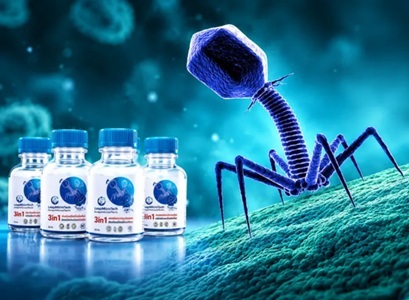
Because a single phage may kill one strain but not another, the team combined several into a cocktail. That work has led to LeapMicroTech’s “3in1 Jumbophage cocktail,” a phage-based product for bacterial disease control in aquaculture.
In a field comparison at a commercial farm, researchers studied two neighboring ponds, one given phage-treated feed and one left untreated. Around day 29 of the production cycle, the untreated pond suffered a die-off the farm estimated at about 100,000 shrimp in a single day, with samples consistent with EMS. After the team introduced the cocktail into the affected pond, no further deaths were observed within a couple of days, and the disease-associated bacteria appeared to have been eliminated. The pond receiving phage feed saw no mortality during the observation period. The researchers say such results still require controlled validation.
“While this cocktail delivers a highly targeted approach for controlling bacterial outbreaks compared with conventional antibiotics, its broader value lies in its exquisite bacterial specificity,” Chaikeeratisak said. “By selectively eliminating pathogens, it preserves beneficial microorganisms and provides a viable strategy to combat antibiotic-resistant strains.”
More research
Chaikeeratisak said the biggest hurdle may be human habits, since farmers who have relied on familiar products for years may be wary of a treatment based on viruses. Field demonstrations, he said, will be key.
Chaikeeratisak and team are working toward a proposed Center for Applied Phage Science and Discovery at Chulalongkorn, which would expand Thailand’s phage library and link researchers, clinicians, veterinarians, industry and government. The researchers are also exploring jumbophages against bacterial diseases in chickens and pigs, though those applications remain at earlier stages.
Data from Chulalongkorn University