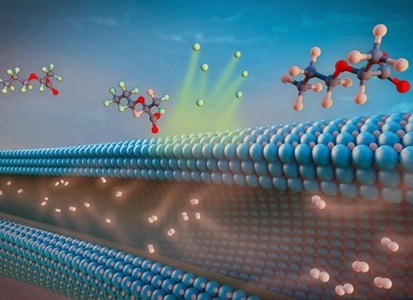
A palladium-coated membrane uses hydrogen to help break down PFAS forever chemicals. Credit: Graphic by Jason Drees
Researchers at Arizona State University are attacking forever chemicals in a new way—rather than filtering PFAS out of contaminated water, they have developed a technique to destroy them.
Most conventional PFAS treatments separate the chemicals from water, but contaminants remain in spent filters, brines or concentrated waste that must still be handled or disposed. The new approach is designed to go a step further by breaking the chemicals apart rather than simply moving them somewhere else.
In this study, the researchers used palladium nanoparticles as catalysts to convert hydrogen gas into a highly reactive form capable of stripping fluorine from the PFAS molecule. The catalytic membrane works by bringing the PFAS molecules and highly reactive hydrogen together at the surface of the palladium catalyst. Hydrogen travels through the membrane and is attracted to the palladium, where hydrogen-gas molecules split into individual hydrogen atoms. PFAS molecules approaching from the surrounding water also attach to the palladium surface.
The way the hydrogen is delivered is critical. Rather than simply mixing hydrogen into the water, the researchers feed it from inside the membrane directly into the base of the palladium layer.
In tests, for nearly two months, the system continuously treated water containing a mixture of six PFAS. It removed more than 90% of each compound and stripped away about 83% of the fluorine overall, showing that the pollutants were being chemically dismantled rather than merely filtered out.
The 58-day test showed the system could operate continuously, but translating the technology into practical water treatment will require further engineering.
One practical hurdle is cost—the ASU team says reducing the amount of palladium needed is one of their top research priorities as palladium is currently about $50,000 a kilogram.
The technology could eventually complement existing PFAS-removal systems. Conventional treatment could first concentrate the contaminants from large volumes of water into a smaller waste stream, which could then be treated to destroy the PFAS rather than simply store or dispose of them.
Data from Arizona State University