Researchers have proposed a new strategy for the development of new drugs based on the inhibition of tyrosine kinase enzymes, molecules that activate and trigger many cellular processes.
Tyrosine kinases are a set of enzymes that are essential for communication between the cells of our body, which trigger biochemical reactions that are important for life.
"The dysfunction of these enzymes is related to serious diseases such as diabetes, some neurological disorders and many types of cancer," explains Ignacio Alfonso, a researcher at the IQAC-CSIC.
The new strategy does not inhibit the kinases, but covers and blocks molecules on which the kinases act. The tool for this would be artificial synthetic receptors, that is, synthetic molecules that would protect the place where the kinases exert their action. The research is published in Chemistry - A European Journal.
"Our group has designed molecules that interact with the substrates of the kinase, and not with the kinase" explains Alfonso. "We have prepared artificial molecular 'cages', made up of pseudopeptides, that are able to modulate the activity of these enzymes.”
Despite being a proof-of-concept study, the results of this study could lead to more selective modulators/inhibitors of these kinases that would be used as research tools for the full understanding of this complex communication network.
"This approach generates basic knowledge, which could be essential to better understand key biological functions and the origin of many diseases," concludes Alfonso.
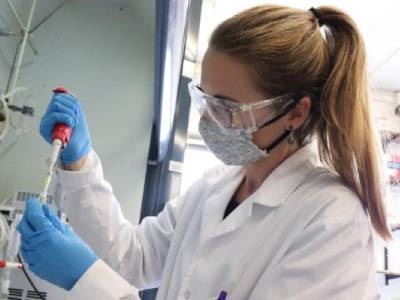
Photo: Lucía Tapia, author of this study, at the Institute for Advanced Chemistry of Catalonia. Credit: Alejandro Rodríguez/IQAC-CSIC