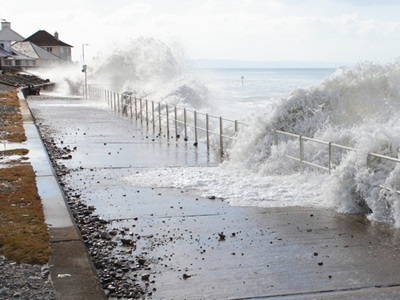
In 1900, coastal communities could expect certain extreme water level events to occur on average 1 in 100 years. Now, the same extreme water level is expected about 1 every 8 years, on average, due to the increase in sea level.
The catalyst for increased coastal water level extremes and associated flooding is sea level rise, which has increased globally by nearly eight inches over the past 126 years.
In this study, using various observational data sets and leveraging model simulations, researchers at the University of Central Florida were able to distinguish the various factors that cause sea level rise. Although natural variability is still a large factor, anthropogenic forcing is now the primary cause.
“We leveraged tide gauge and satellite observations along with existing model outputs to distinguish between the part of sea level rise that could easily be natural variability—the ups and downs we’ve experienced for hundreds of thousands of years—and the part that cannot be explained by natural variability,” said study author Thomas Wahl, UCF Coastal faculty cluster initiative member. “And we found that anthropogenic forcing alone leads to a 4x increase in this likelihood of a one-in-a-100-year event to occur, and it’s now the main driver of the increased likelihood of these extreme water levels to occur.”
Recently, Wahl also contributed to a study published in Nature Geosciences that reveals that sinking ground levels and rising sea levels are occurring more rapidly than previously understood, often worsening flooding in coastal communities.
The research team says these combined findings show a need to reassess coastal infrastructure and flood-planning efforts as past flood frequency estimates may no longer represent modern-day conditions.
Data from University of Central Florida