The development of methods for preventing and detecting viral diseases has gained momentum since the beginning of the COVID-19 pandemic. Improvements in personal protective equipment (PPE) and diagnostic technology have helped reduce infections, provided faster and more accurate results and expanded the toolbox for combating the contagion. Now, engineers from MIT and Harvard University have created a prototype that combines prevention and detection into one product.
The research team designed a novel face mask that can diagnose the wearer with COVID-19 within about 90 minutes, using tiny disposable sensors embedded into the fabric. The sensors are based on technology developed by MIT engineer James Collins in 2014, when he created paper diagnostic tests for the Ebola and Zika viruses by embedding paper with synthetic gene networks of protein and nucleic acids that react to specific molecules. The technology was further developed into a sensor system called SHERLOCK in 2017, which is based on CRISPR enzymes and allows for highly sensitive detection of nucleic acids.
Collins and his colleague were working on embedding these highly sensitive sensors into wearable items, such as lab coats, when the COVID-19 pandemic began. The team then worked to adapt the technology to detect SARS-CoV-2, and developed a system that could be embedded into an N95-equivalent mask.
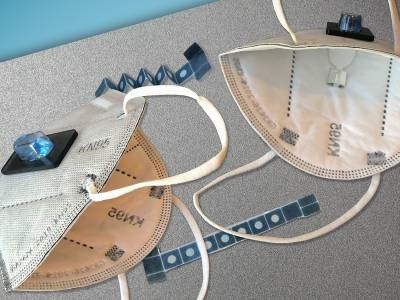
The prototype mask has freeze-dried SHERLOCK sensors embedded into the mask material, surrounded with a silicone elastomer to prevent evaporation or diffusion of a breath sample away from the sensor. The freeze-dried components are activated by the push of a button that releases water from a small reservoir inside the mask. Once hydrated, the SARS-CoV-2 sensors analyze accumulated breath droplets from the mask wearer. A lateral flow assay (LFA) strip is also included to display a color change if viral particles are detected. The strip is located on the inner part of the mask so the results can be viewed privately. This research was published in Nature Biotechnology.
“This test is as sensitive as the gold standard, highly sensitive PCR tests, but it’s as fast as the antigen tests that are used for quick analysis of Covid-19,” said Peter Nguyen, a Harvard researcher and lead author on the paper.
The sensors in the mask could also be swapped out with different sensors to detect other viruses such as influenza, Ebola and Zika, or other sensors the team has developed to detect organophosphate nerve agents. The sensors could be placed inside or outside of the mask to diagnose the wearer or to detect environmental exposure, respectively, and the results could be delivered through colorimetric means, through fluorescence or luminescence outputs or through a wearable spectrometer that wirelessly transmits results to the wearer’s mobile device. The researchers have filed a patent for the technology and hope to work with a company to further develop the sensors.
Photo: Engineers at MIT and Harvard designed a prototype face mask that can diagnose the person wearing the mask with COVID-19 within about 90 minutes. Credit: Felice Frankel and MIT News Office