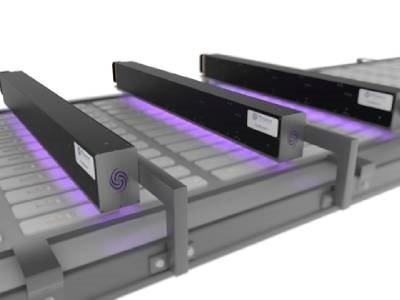
The world’s largest UVC LED disinfection system has been deployed for mass decontamination of COVID-19 test kits during manufacturing.
Phoseon Technology announced this month that construction of its scaled-up KeyPro system, designed to inactivate RNase A in COVID-19 reverse transcriptase-PCR test kits, was completed following a request from a major healthcare organization to aid in decontaminating molecular diagnostics tools.
“From the first customer interactions to the design and implementation of the system, we continue to support this healthcare organization as experts in the field,” said Theresa Thompson, PhD, application scientist at Phoseon Technology.
The new system will be used to help scale up production of COVID-19 tests without compromising accuracy of test results. Phoseon’s system uses patented Semiconductor Light Matrix technology that combines LED arrays, optics and thermal cooling technology to optimize disinfection performance and productivity.
UVC LED disinfection technology has also been applied to packaging, pharmaceuticals, food safety and other industries that must remain contaminant-free.
Photo: The world's largest UVC LED disinfection system, built by Phoseon Technology, was designed for mass decontamination of COVID-19 reverse transciptase-PCR test kits. Credit: Phoseon Technology