Thermal-imaging sensors have been used as a contactless way to screen body temperatures during the COVID-19 pandemic, and have led smartphone manufacturers to look into adding thermal imaging to the capabilities of everyday mobile devices. In order for these sensors to be integrated into the hardware of smartphones, they would need to be able to operate normally at temperatures of up to 85 degrees Celsius, which conventional thermal-imaging sensors cannot do without the use of a cooling device. Cooling devices can be costly and use up a lot of energy, which is why a joint research team from the Korea Institute of Science and Technology (KIST) and Sungkyunkwan University (SKKU) sought to develop sensors with more built-in thermostability to make thermal-imaging with smartphone cameras much more feasible.
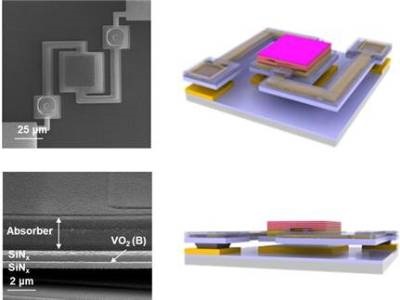
The team’s microbolometer design combines a thermostable vanadium dioxide (VO2)-B film that can withstand temperatures of up to 100 degrees Celsius with five-stack titanium/magnesium fluoride (Ti/MgF2) infrared (IR) absorbers. The design not only allows the sensor to remain stable at high temperatures without a cooling device, but also maximizes the amount of external IR radiation that can be absorbed and converted into electrical signals.
The researchers found that their microbolometer detected heat signatures with three times more sensitivity than conventional sensors and had a 3 millisecond response time even at a maximum temperature of 100 °C. These advantages make the design a promising candidate for use in smartphones and even as a safety feature in autonomous vehicles. The research was published in Applied Surface Science.
“By means of our work with convergence research in this study, we have developed a technology that could dramatically reduce the production cost of thermal-imaging sensors. Our device, when compared to more conventional ones, has superior responsivity and operating speed,” said lead researcher Won Jun Choi. “We expect this to accelerate the use of thermal-imaging sensors in the military supply, smartphone, and autonomous vehicle industries.”
Removing the need for a cooling device can reduce the costs of producing thermal-imaging sensors by more than 10% and reduce the amount of energy needed to produce a heat signature. With the ability to capture thermal images at 100 frames per second, the team’s microbolometer shows potential for advanced applications in addition to smartphone integration.
Photo: Electron microscope image (left) and formula illustration (right) of the microbolometer design. Credit: Korea Institute of Science and Technology (KIST)