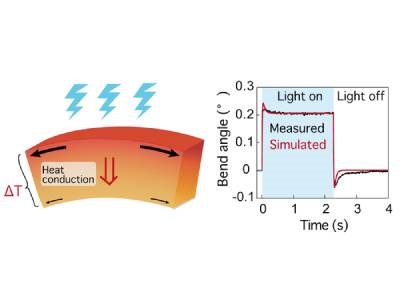
The ability of some crystals to bend when excited with light could be applied to the development of new materials for actuators, artificial muscles and soft robotics. However, photoisomerization, in which molecules change their structure by absorbing light, is limiting due to its slow actuation speed, limited choice of wavelength to induce the reaction, and inability to bend crystals more than about 20 microns thick. Researchers at Waseda University recently validated a more flexible mechanism for bending crystals that could help material engineers overcome the limitations of photoisomerization.
The researchers examined how the photothermal effect could allow thicker crystals to bend at a higher speed due to the heat generated by the excitation of the crystal. The researchers had found by accident that the photothermal effect caused thick crystals to bend, and sought to further investigate the underlying mechanism in order to hone and validate the method. When exposing salicylideneaniline derivative crystals of different thicknesses to UV light, the researchers saw that the bend angle from photoisomerization rapidly decreased with increasing thickness. However, when crystals greater than 40 microns thick were excited, the researchers observed rapid bending within milliseconds, even when visible light was used. By using pulsed UV light, the researchers were able to make the thick crystals bend at a frequency of 500 Hz.
The team performed temperature wave analysis (TWA) to determine the thermal diffusivity of a crystal and proposed that heat conduction near the irradiated crystal surface resulted in a non-steady temperature gradient along the thickness direction, causing it to bend. By measuring the surface temperature of an irradiated crystal using an IR thermography camera, the team calculated the temperature gradient and were able to accurately simulate the bending motion. The research was published in the Journal of the American Chemical Society.
“As the photothermal effect occurs in almost all crystals that absorb light, any light may move any crystal at high speeds,” said Hideko Koshima, who led the research. “Further, the bending motion can now be simulated, providing the basis for practical applications such as in light-driven actuators. What’s more, these light-activated mechanical crystals can be used to create novel soft robotic structures that ensure safe human-robot interaction.”
The researchers expect the photothermal method will expand the potential of crystals as actuation materials, allowing engineers to work with more crystals that do not show photoisomerization.
Photo: Waseda University researchers showed how the photothermal effect enables a high-speed bending motion in thick crystals, opening doors to light-driven mechanics with more versatile crystals. Credit: Waseda University