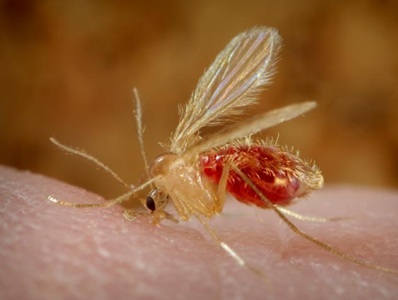
A bite from an infected female sand fly is the main way people contract leishmaniasis. Many may not notice the bites because sand flies are silent, very small, and the bites are usually painless. Credit: James Gathany via The Ohio State University Wexner Medical Center
Abhay Satoskar, MD, PhD, has spent his career looking for a way to develop a safe vaccine against leishmaniasis, a disfiguring skin disease. Earlier attempts used parasites that could spread in the body and included antibiotic-resistant genes, making them unsafe for human use.
A game changer was the development of CRISPR gene-editing technology. Satoskar and his team realized they could use CRISPR to remove the gene from the skin-only species of the parasite and create a safer vaccine that can train the immune system without causing disease.
“It worked beautifully. It worked beyond my imagination, to be honest,” said Satoskar.
In animal studies, the vaccine was 100% effective. Last year the U.S. Food and Drug Administration approved the vaccine as an investigational new drug, and this year clinical trials are expected to start.
Leishmaniasis is a disease caused by tiny parasites that are spread through the bite of an infected female sand fly, which is much smaller than a mosquito. For decades, it was predominantly found in tropical regions like Africa, the Middle East and South America. It is now endemic in other regions such as Europe and the U.S. because of deforestation and climate change.
There are three main forms of the disease. Cutaneous leishmaniasis is the most common form of leishmaniasis and presents as one or more skin sores or ulcers that can take months to heal, bumps that may slowly grow larger or scars that remain after healing. With mucosal leishmaniasis, parasites infect cells lining mucosal areas, causing disfiguring lesions of the mouth, nose, sinuses, palate and vocal cords. Visceral leishmaniasis is the most serious form of leishmaniasis and affects internal organs, especially the spleen, liver and bone marrow. Symptoms may include fever, weight loss, weakness, enlarged liver and spleen or anemia. Visceral leishmaniasis can be life-threatening without treatment.
The World Health Organization lists leishmaniasis as one of the top neglected tropical diseases in the world. At any given time, about 6 million people are infected with up to 1 million new cases annually. More than 1 billion people in 99 territories and countries where leishmaniasis is endemic are at risk of getting the disease.
“In the last two years, we’ve seen on average two to four cases per year at Ohio State. In the past we used to see maybe one case per year. It’s definitely been ticking up over time in the U.S.,” said McGwire.
This summer, Satoskar has been traveling the world meeting with the vaccine manufacturer, investors and leishmaniasis experts as his team prepares to start the first human trials in Brazil and Kenya. Plans are to add a U.S. site. Satoskar is passionate about raising awareness about the vaccine as well as a skin test that he helped developed that is similar to a tuberculosis test. The skin test would help detect the disease and track its spread.
“Because this is a new disease in the U.S., many physicians don’t know that a mysterious skin disease they’re seeing may be leishmaniasis. We’re hoping to get the word out to educate more people,” he said.
Data from Ohio State University