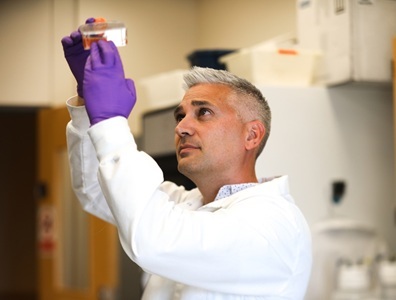
Research from the lab of Jonah Sacha, Ph.D., at OHSU, has identified a one-time regimen of therapies for newborns with HIV that, if given within three days of birth, could permanently clear the virus. The research team hopes to use the animal model results to move into a human clinical trials. Credit: OHSU/Christine Torres Hicks
A combination of three existing HIV therapies, given to newborn primates within three days of infection, permanently cleared the virus in a new study—a result researchers say could move quickly toward human clinical trials.
For the study, published in Nature Microbiology, researchers at Oregon Health & Science University tested the combination in nonhuman primates at the Oregon and California national primate research centers. More than 120,000 newborns worldwide contract HIV each year, a burden that typically requires lifelong treatment.
The team combined three treatments—neutralizing antibodies, standard antiretroviral therapy, and an experimental monoclonal antibody called leronlimab—administered over several weeks. Each therapy had been tried on its own in the past and failed to fully clear the virus. Leronlimab works by blocking HIV from entering immune cells through a surface protein called CCR5.
Nancy Haigwood, a longtime OHSU virologist and coauthor who proposed combining leronlimab with the other therapies, described the result using three analogies: antiretroviral therapy as "turning off the faucet" to slow viral replication, neutralizing antibodies as "mopping up" circulating virus, and leronlimab as "sealing off" the last remaining path for the virus to infect new cells.
The combination appears especially potent early in infection.
“There's a lot more going on during the first week of infection than we previously thought,” said Haigwood. “From this experiment, it looks like there's a dynamic interaction between the virus and antibodies that takes place as the virus begins to spread.”
Antiretroviral therapy is already approved for use in people, while neutralizing antibodies and leronlimab are each being tested separately in clinical trials. Researchers say the anatomical similarity between primates and humans gives them confidence the approach could translate, though the regimen would need to be tested in people—likely newly exposed adults first—before it could help address an HIV epidemic that kills 600,000 people worldwide each year.
The team is eager to see whether the treatment window can also be extended.
“We only tested out to three days. Could it work a week after infection? Two weeks? How far can you go after infection, and still purge the virus?,” said co-lead author Jonah Sacha, professor and chief of pathobiology and immunology at OHSU's Oregon National Primate Research Center and Vaccine and Gene Therapy Institute.
Data from Oregon Health & Science University