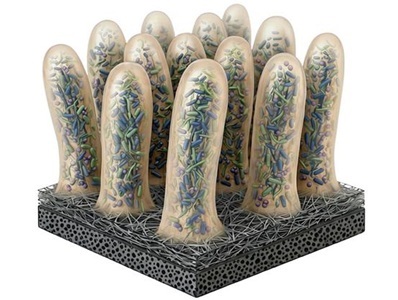
New biobatteries developed at Binghamton University are inspired by the finger-like protuberances called villi that line the digestive tract and help us to digest. Credit: Ruohan Zhang, Botian Wang, Seokheun Choi, "Intestinal Villi-Inspired Living Biobatteries via Habitat-Engineered Conductive Hydrogel Architectures"
The incredible adhesion properties of gecko's feet inspired scientists to create specialized tapes and climbing pads for precision robotics, medical closures and space exploration. The way the kingfisher bird from the air into water with almost no splash because of its long, tapered beak inspired engineers to redesign the nose of Japanese bullet trains.
Tubercles (or bumps) on the leading edges of humpback whale flippers help the massive animals maneuver tightly and reduce hydrodynamic drag. Inspired by this, engineers added tubercle-style bumps to wind turbines and industrial fan blades to generate more lift, reduce noise and increase energy capture efficiency by up to 20%.
These are all examples of biomimicry, the practice of emulating nature's processes to solve human challenges. In new research for a bacteria-powered biobattery, scientists at Binghamton University looked a little closer to home for inspiration: the human small intestines.
Finger-like protuberances called villi line the digestive tract and are covered with microorganisms that help humans digest food. Their shape and behavior also prove to be ideal for generating bioenergy using spore-forming bacteria.
For this latest research, published in Small, the Binghamton team fabricated the villi-inspired structures out of a dormant yet flexible polymer hydrogel commonly used for biomedical applications. They seeded inactive bacteria throughout the villi, which act as the biobattery’s anode. To generate small amounts of electricity, the villi are separated from a modified carbon-cloth cathode by an ion-exchange membrane.
With a constant supply of nutrient medium, the villi device maintained a stable output of about 0.75 volts for at least 14 hours—enough to light small LEDs or power microsensors. One possibility for future use would be self-powered wastewater treatment.
The researchers want to improve the manufacturing process for the villi-inspired biobatteries by developing a single-step, scalable printing method. They also want to move the design even closer to how human bodies work—with bacteria in our digestive tract staying mostly near the surface in a mucous layer that coats the villi.
“In this work, we tried to mimic architectural part,” said study author and professor Seokheun “Sean” Choi. “We need to mimic their actual physiological and chemical makeup to truly understand how those bacterial cells can maintain their viability.”
Data from Binghamton University