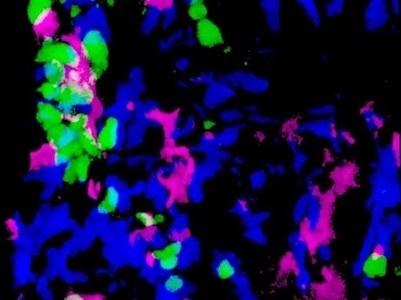
While T cells help protect the body against cancer and viruses, new research shows that some T cells can also limit the body’s ability to regenerate tissue. Here, CD4+ T cells (green) kill progenitor cells, which help drive tissue regeneration. As the progenitor cells die, they appear magenta. Credit: James Godwin, Ph.D.
Some immune cells in mice can attack and kill the very cells needed to rebuild bone, while a subset of those same immune cells can shield the bone-making cells and allow regeneration to continue, according to new research from The Jackson Laboratory (JAX).
The work highlights how the delicate but crucial interplay of immune cells shapes the body’s ability to replace damaged or lost tissue with new, healthy tissue. It could also help explain why people heal differently after injury and point to potential therapies for improving tissue regeneration.
The study, published in npj Regenerative Medicine, examined the role of adaptive immune cells in fingertip regeneration. Like humans, mice have a limited ability to regenerate multiple tissue types at the tips of their digits after injury, including bone, skin and nail, making the process a useful model of mammalian tissue repair.
JAX Senior Research Scientist James Godwin wanted to understand the role of adaptive immune cells, which learn to recognize specific threats such as viruses and cancer cells, in fingertip regeneration.
His team used 16 genetically diverse types of mice, including some lacking different types of immune cells. Regeneration was faster and more effective when adaptive immune cells were absent.
The researchers found that CD4+ T cells, sometimes called “helper” T cells because they coordinate immune responses, strongly inhibited regeneration. Further experiments showed these cells could kill progenitor cells, the immature cells that give rise to the specialized cells needed to rebuild bone.
The team also identified an immune signaling molecule called interferon-gamma as a major driver of this cytotoxic activity—when CD4+ T cells couldn’t produce it, they no longer blocked regeneration.
“CD4+ T cells are negative forces in this context, but they’re also the guardians of our body in terms of cancer and viruses,” Godwin said. “It’s possible that because our human body has evolved to balance the ability to repair and the ability to ward off these threats, that we’ve landed in this situation where we don’t have a lot of regenerative capacity, but we have good cancer and viral surveillance.”
Not all CD4+ T cells behaved the same way, however. Regulatory T cells, or Tregs, a subset that normally keeps immune responses under control, protected the cells involved in rebuilding the fingertip from attack by other CD4+ T cells. Without Tregs, regeneration was delayed and the immune system began damaging uninjured bone. Adding Tregs restored regeneration, as did raising levels of RANKL, a naturally occurring molecule that helps control bone breakdown and remodeling. The findings offer insight into how the immune system interacts with bone and how that balance may be disrupted by disease and aging.
More work is needed to determine whether similar mechanisms operate in human tissue. But the results could inform research into stem cell and progenitor cell therapies for severe injuries, since transplanted cells often struggle to survive.
“In the future, if somebody had an injured spinal cord or major damage to one of their bones, we might be able to use targeted immunotherapy to temporarily shift the immune system and ramp up the cells that support regeneration while suppressing those that interfere with it,” Godwin said. “We don’t have a therapy ready, and we’re not ready to go into a patient, but identifying what needs to change is an essential step toward getting there.”
Data from The Jackson Laboratory