Cryogenic electron microscopy (cryo-EM) has become a gold standard technique for atomic resolution imaging of tiny particles, such as viruses, and can be used to create detailed 3D reconstructions of these particles’ structures. While extremely valuable, cryo-EM can only produce static images of frozen particles and doesn’t reveal how a specimen would move and change in nature. In order to study the movements of viruses in liquid and record these movements in high resolution, Penn State researchers recently turned to liquid phase electron microscopy (LP-EM), and managed to capture videos of the changes in a virus particle’s surface with near-atomic detail.
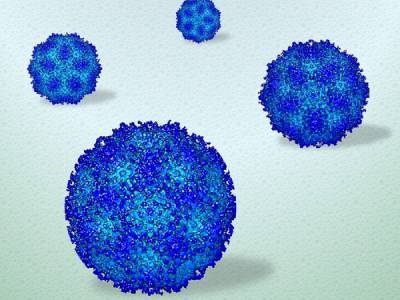
Rather than flash freezing their sample as done in cryo-EM, the researchers kept adeno-associated virus (AAV) particles in a liquid solution and applied the virus-containing solution to the wells of silicon nitride microchips. The AAV particles in the chips were examined by EM, and the images were processed and assembled like the frames of a movie to show the subtle movements of the virus over several seconds. The images were also used to produce detailed 3D reconstructions of the virus' behavior (see below).
The resolution of the images was close to 3-4Å, comparable to cryo-EM but with less complicated sample preparation, said first author GM Jonaid. After their success with imaging AAV, the team also used the technique to study antibodies in the serum of COVID-19 patients, and observed how they interacted with remaining SARS-CoV-2 particles. The study was published in Advanced Materials.
“While cryo-EM can tell us a lot of information, it still produces a static image. With improved chips and a powerful direct detector on the microscope, we can accumulate a lot of movie frames to view how the sample acts in real time,” said Jonaid. “We can see things how they exist — not just how we prepared them.”
The researchers plan to continue using LP-EM to investigate the molecular underpinnings of SARS-CoV-2 and host-receptor proteins, using the technique as a complement to cryo-EM to get a more complete picture of the structure and dynamic movements of these biological particles, according to lead researcher Deb Kelly.
Photo: 3D reconstruction created from high-resolution LP-EM images of AAV particles in liquid. Credit: Deb Kelly, Penn State
Video Credit: Penn State College of Engineering
Video Credit: Penn State College of Engineering