The ability to recycle electronic parts and reuse them to create new devices both reduces the waste that can harm the environment and saves costs and resources by extending the lifespan of materials. Nanowires have been used to develop low-cost, disposable electronics, such as flexible biosensor patches, which, despite their small size, can result in additional electronic waste and underuse of the sometimes rare and precious materials they are constructed from. Scientists at North Carolina State University have proposed a method for recycling and reusing nanowires in order to conserve these valuable resources and develop more sustainable electronics.
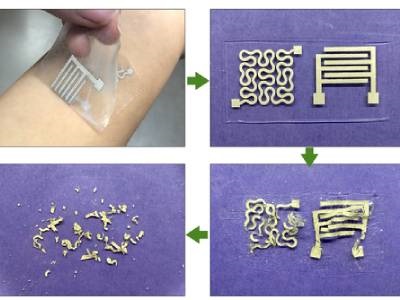
The team demonstrated their technique for recycling transient epidermal sensor patches containing silver nanowire networks using low-cost solvents and ultrasonication. Firstly, the patches were constructed by embedding the nanowire network into a water-soluble polymer matrix so that the polymer could later be dissolved and separated away from the nanowires. The team tested the patch, used to monitor the wearer’s temperature and hydration, to ensure it was fully functional, then began the recycling process by placing the patch in water, breaking down the polymer components.
Once the polymer and silver nanowires were separated, the remaining network fragments were placed in isopropanol and hit with ultrasound for 20 seconds, causing the nanowires to further separate out of the network. Once left with a collection of separated nanowires, the team reused them to build another sensor patch, and found that the recycled wires remained fully functional in the new patch. The researchers repeated this process several times with the same set of wires and found that while there was minor degradation of the nanowire network after each life cycle, this did not harm the sensor’s performance for up to four life cycles. The research was published in Advanced Electronic Materials.
“Using our approach, you get far more use from the nanowires,” said corresponding author Yong Zhu. “And even after the nanowires have broken down many times, to the point where they can’t be reused, we can still use them as feedstock for conventional recycling. It’s a tremendous reduction in waste.”
First author Yuxuan Liu noted that using a solvent with low surface tension is important to allow for diffusion into the narrow junctions between nanowires within a network. The researchers added that the recycling method could potentially be used with other nanomaterials that form a network, such as carbon nanotubes and 2D materials.
Photo: Part of the recycling process, from removal of the patch to separation of the polymer matrix by soaking in water, leaving behind nanowire network fragments. Credit: Yong Zhu, NC State University