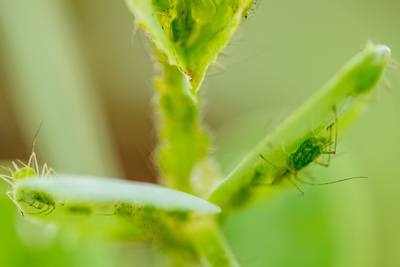
Farmers have to grapple with a number of natural antagonists in order to keep their crops safe and healthy, and this includes devising effective strategies to fend off pests and diseases. For pea farmers, piercing-sucking aphids that carry viruses are among the most worrisome of their natural enemies. To better understand how the pea plant forms its own defenses against bug-borne disease, researchers from Washington State University (WSU) tested whether insect attack order would impact the plant’s chemistry and gene expression.
For the study, researchers examined the attack order of pea aphids (Acrythosiphon pisum) and another common pest, the pea leaf weevil (Sitona lineatus). While both insects can damage pea plants, A. pisum are especially dangerous because they can transmit pea enation mosaic virus (PEMV). In a greenhouse, the researchers introduced aphids and weevils in different orders to pea plants that were either infected or not infected with PEMV. After removing the insects and allowing the plants to grow for a week, the team then collected plant samples and tested phytohormone levels using liquid chromatography-tandem mass spectrometry (LC-MS-MS) and amino acid nutrient levels with LC and fluorescence detection. The team also used qRT-PCR to measure the expression of genes related to defense against diseases.
The analyses revealed the complex relationships between attack order, PEMV, pea plant defenses and nutrition. The researchers found that when weevils fed first, the plants’ anti-pathogen defense responses were enhanced, making them more resilient to viral infection. However, when the aphids fed first and the weevils second, the plants’ anti-pathogen responses were reduced, and the virus spread more easily. Additionally, plants that are already infected with PEMV have a stronger anti-herbivore response than those that are not infected, interfering with the pests’ ability to feed. And while weevil feeding induced a stronger anti-pathogen response, it also reduced the plants’ available amino acids, lowering their nutritional value. The study was published in Molecular Ecology.
“If we know beforehand when these interactions are happening, that information gives farmers a best possible remedy to prevent their fields from attack,” said lead author Saumik Basu. “This kind of information is really important for designing sustainable pest and pathogen management strategies.”
The researchers aim to conduct more studies that focus on the interactions between plants and multiple different attackers, rather than focusing on one pest or pathogen at a time. An upcoming study will examine the interaction between plants, weevils and the nitrogen-fixing bacteria rhizobia.
Photo: Pea aphids (Acrythosiphon pisum) feed on pea plants and can transmit pea enation mosaic virus (PEMV). Credit: Bob Hubner, WSU Photo Services