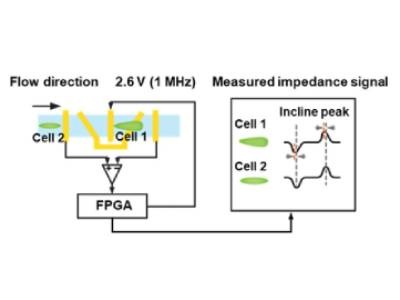
Methods for monitoring, counting and sorting single cells have become automated through technology like flow cytometry, but bottlenecks still remain in some areas. For example, determining a cell’s shape and symmetry typically requires imaging technology, and automating this process can require advanced and expensive software and equipment. Researchers from the Nara Institute of Science and Technology recently tested a method for speeding up and simplifying the process of screening cell shape by eliminating the need for optical equipment and instead measuring changes in electrical impedance.
The method is based around impedance flow cytometry, which measures electrical changes as individual cells pass through microfluidic channels. The researchers introduced a new metric they called “tilt index,” which is zero for symmetrical, spherically-shaped cells and nonzero for asymmetrical, elongated cells, according to lead author Yaxiaer Yalikun. This metric was found to be sensitive to cell shape but not affected by the cell’s trajectory through the channel. The team’s impedance flow cytometry setup included a nonlinear electrode layout, a sinusoidal excitation voltage with a frequency of one megahertz and a specially-built lock-in amplifier for signal detection.
The team tested their system with both polystyrene beads between 10 and 25 microns in diameter and with live Euglena gracilis cells of varying shapes. Their experiments demonstrated that the method could accurately and reliably differentiate between microscopic objects of different shapes, without the need for optical equipment. The study was published in Biosensors and Bioelectronics.
“Reducing the cost of automated monitoring is an important step for making new biotechnologies commercially viable,” said senior author Yoichiroh Hosokawa.
An inexpensive method for automatically and rapidly differentiating cell shape can be a valuable tool for future biology research and applications, as changes in cell shape can sometimes be a sign of stress. Future versions of the impedance flow cytometry system could be incorporated directly into cell growth systems as a quality control measure, according to the researchers.
Photo: The principle of the proposed method. A wave forms when a microscopic object passes through a microfluidic channel with electrodes. The wave indicates tilt, which is correlated to the shape of the object. Credit: Yaxiaer Yalikun