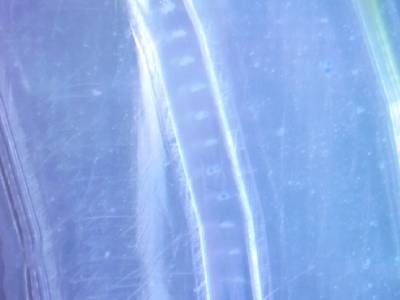
Acoustic tweezers offer an innovative, contactless method of manipulating small particles using sound waves, but often require many sound sources and solid channels to guide particles through complex patterns in liquid. Using solid boundaries to help move the particles can slow down their movement and even damage them, while moving particles suspended in liquid without internal channels makes it difficult to move them independently or in complicated patterns. Engineers at Duke University recently found a way to manipulate particles in liquid in a complex manner without additional structures, using only two sound sources and a unique “shadow waveguide.”
The team’s approach is inspired by metamaterials — synthetic materials engineered to produce properties not found in nature. The engineers created two 3D printed molds in half-tube shapes, then filled the molds with polydimethylsiloxane (PDMS), a silicon-based polymer with acoustic properties similar to water. The molds included features to create air channels in the final product that would dictate the movement of sound based on the path the researchers wanted the particles to take. With the PDMS “shadow waveguides” placed outside a liquid-filled chamber, the sound produced by the two sources passed through the guides and created complex, tightly-confined acoustic fields capable of manipulating particles in the desired path without the use of solid structures inside the chamber. The study was published in Science Advances.
“Acoustic devices are very difficult to make reconfigurable, but we would love to figure out a way to make that possible because it would be a dramatic improvement in this technique’s usability,” said first author Junfei Li. “For now, we’re looking for specific challenges that we could adapt these shadow waveguides to address to move it from a proof-of-concept demonstration to a more sophisticated application.”
Corresponding author Steve Cummer said the team may merge their concept with other existing acoustic tweezer approaches, including the addition of multiple sound sources, to create more complexity in the acoustic fields.
Photo: There are no physical structures in this photo. The "walls" guiding the particles through the liquid are a complex combination of sound waves created by a "shadow waveguide." Credit: Junfei Li, Duke University