The discovery of programmable CRISPR proteins revolutionized and accelerated the field of genetic engineering, opening up opportunities for new applications including new gene therapies. Despite its precision and efficiency, CRISPR-Cas9 and its relatives still have some limitations, such as their bulky size, which presents a challenge for delivery into cells. A team of researchers at MIT’s McGovern Institute and the Broad Institute of MIT and Harvard have discovered a new class of programmable RNA-guided gene editing proteins that could provide new advantages for genetic engineering due to their smaller size and abundance in nature.
This new group of DNA modifying systems, known as Obligate Mobile Element Guided Activities (OMEGAs), are encoded by the IS200/605 transposon family and include IscB, IsrB and TnpB proteins. The researchers discovered that proteins in this group are guided by small bits of RNA they call ωRNAs, which direct the cleavage of DNA. The researchers used evolutionary analysis, RNA-seq and biochemical experiments to reconstruct the evolution of CRISPR-Cas9 systems from this family of transposons and believe IscB is likely an ancestor of Cas9, while TnpB may be an ancestor of Cas12. The researchers showed that IscB could be engineered for gene editing in human cells and wrote that OMEGAs show promise for the development of future biotechnologies. Their paper was published in Science.
“We are super excited about the discovery of these widespread programmable enzymes, which have been hiding under our noses all along,” said corresponding author Feng Zhang. “These results suggest the tantalizing possibility that there are many more programmable systems that await discovery and development as useful technologies.”
Because OMEGAs are only about 30% the size of Cas9, they could be valuable for more efficient delivery of gene therapies. The research team plans to continue investigating the origins of RNA-guided gene editing systems in the hopes of potentially finding additional systems that could be engineered by scientists.
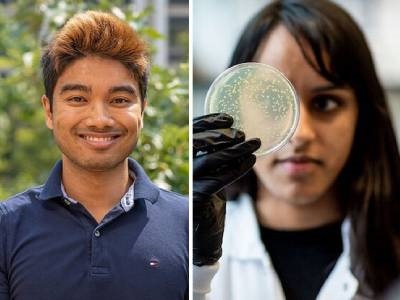
Photo: Han Altae-Tran (left) and Soumya Kannan (right) are co-first authors of the paper describing a new class of programmable gene editing systems outside of CRISPR. Credit: Zhang Lab/Caitlin Cunningham