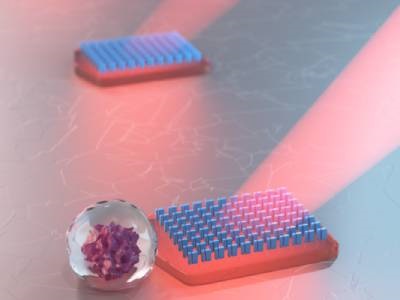
Metasurfaces—ultra-thin arrangements of nanoparticles tailored to direct light—are typically thought of as stationary tools for manipulating light in applications such as photography, microscopy and electronic displays. However, as shown by breakthroughs such as optical tweezers, light can also be used to manipulate objects, and the special properties of metasurfaces offer unique opportunities to explore this function. Researchers from Chalmers University of Technology have now demonstrated that microscopic particles coated with metasurfaces can be precisely moved and steered by changing the polarization and intensity of loosely focused light.
The particles, dubbed “metavehicles” by the research team, are about 10 μm wide and 1 μm thick and are designed to deflect light in a way that also causes the particle to be pushed away in the opposite direction, like “two pool balls” hitting each other, explained paper co-author Mikael Käll. This movement of the metavehicle is not caused by an increase in heat or a chemical reaction brought on by the light, but instead due to mechanical forces between the metasurface and photons in a manner representative of Newton’s third law of motion.
For the experiments, the researchers placed the metavehicles at the bottom of a water dish and then used a loosely focused laser to direct a plane wave of light onto them. By simply adjusting the intensity and polarization of the light, the researchers could control the movement and speed of the vehicles with high precision, and maneuver them into different directions and complex patterns, such as figure eights. The vehicles could also be used to push around and transport other small particles ranging from microscopic polystyrene beads and yeast particles to dust particles 15 times the size of the vehicle itself. This research was published in Nature Nanotechnology.
Video Credit: Chalmers University of Technology
“The metavehicles were stable, and their navigation was highly predictable and controllable. With advanced automated feedback systems, and more sophisticated control of the intensity and polarisation of the source light, even more complex navigation would be possible,” said lead author Daniel Andrén.
Käll noted that while the full potential applications of this technology are not yet known, the ability for the vehicles to be used as transporters shows they could become useful tools for manipulating objects at microscopic scale.
Photo: An illustration of metavehicles pushing another object. Credit: Denis Baranov/Chalmers University of Technology