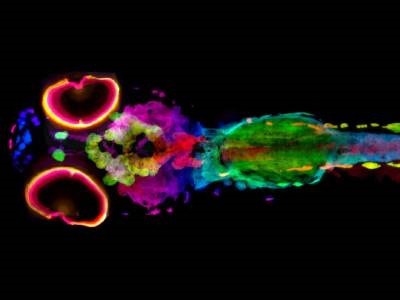
Melanin not only determines our hair, skin and eye color, but also helps protect us from the sun’s UV rays, and can even affect our hearing, eyesight and brain function. Studying melanin can provide insights into conditions such as albinism, melanoma and Parkinson’s disease, but imaging melanin is challenging due to its light-absorbing properties. Researchers at Penn State College of Medicine have now developed a new method for imaging whole organisms in 3D that allows the distribution of pigment cells to be visualized.
The team adapted a technique developed by Penn State professor Keith Cheng in 2019 known as X-ray histotomography, a form of CT imaging that allows cells and tissues to be viewed with unprecedented resolution and clarity. This micro-CT technology provides resolution about 2000 times higher than typical CT scans used for humans and provides detailed 3D visualizations of small organs and tissue samples. The team paired the micro-CT technique with ionic silver staining to bring melanin into focus as they performed 3D scans of whole zebrafish. This method, which leveraged the powerful synchrotron X-ray source at Lawrence Berkeley National Labs, allowed the location and density of all pigment-containing melanocytes throughout the organism to be fully mapped and visualized.
The scans were performed on zebrafish with both typical and mutated pigmentation, including “golden” zebrafish with lighter stripes due to mutation of a gene that is related to a human gene affecting skin color. The experiments allowed the scientists to not only visualize the position of melanocytes in the fish but also obtain quantitative measurements of melanin content to compare between mutant and non-mutant fish. This research was published in the journal eLife.
The efficacy of this new technique can allow the researchers to further study melanin-related conditions such as melanoma, which involves the overproduction of melanocytes. The researchers can use their technology to scan both zebrafish models for melanoma and human tumor samples to better characterize the number and arrangements of tumor cells. Additional research could provide insights into albinism, which involves the absence of melanin, and Parkinson’s disease, which is associated with a decrease in neuromelanin, a pigment found in the brain.
Photo: Melanin is visualized in a silver-stained, 5-day-old zebrafish using X-ray histotomography. The different colors were assigned based on the depth of the melanin in cells within the sample from top to bottom. Credit: Keith Cheng Lab, Penn State College of Medicine