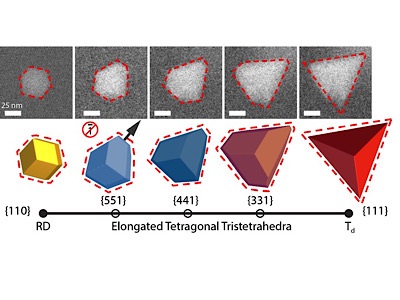
Nature has a tendency to produce symmetry, which can be seen in examples such as snowflakes, planets, plants and animals, including humans. The structures of many crystals also reflect this affinity for symmetry, but just as there are exceptions in the biological world, such as with flounders and hermit crabs, there are also exceptions to crystal symmetry. While animal asymmetry can be explained by evolution, crystal asymmetry is not as well understood. Recently, a research team from Rice University utilized liquid flow cell transmission electron microscopy (TEM) to observe nanocrystal growth under different conditions and uncovered a mechanism that could allow scientists to produce more asymmetrical crystals for use in unique materials.
Liquid cell TEM allowed the team to flow fluid containing ligands and precursors through the cell as they watched through the cell window and pinpointed when cell growth takes a turn toward asymmetry. By balancing thermodynamic and kinetic forces within the cell, the team managed to make an asymmetrical tetrahedron nanoparticle grown from a symmetrical “seed” of gold, revealing that certain conditions and growth speed caused gold atoms to attach themselves to particles at their tips and edges, rather than the thermodynamically favored faces of the nanoparticle. This research was published in ACS Nano.
Video: A growing gold nanoparticle captured at Rice University through liquid cell transmission electron microscopy shows the particle’s transformation into a tetrahedron. Credit: Courtesy of the Jones Research Group.
“Now that we’re able to screen a range of conditions, we were able to see a spectrum with kinetic growth on one end and equilibrium on the other,” said corresponding author Matthew Jones. “Kinetic growth is rapid and protrusions grow very quickly and it’s not very well controlled. In equilibrium, growth is slow and the system does what it wants to do, which is to maintain symmetry.”
Jones said the research not only opens up more possibilities for asymmetrical crystals to be synthesized in laboratories as building blocks for metamaterials, but also shows what researchers can accomplish when using liquid cell TEM to observe and analyze dynamic chemical processes.
“There’s nothing quite like being able to watch the whole thing happen,” Jones said. “That’s what this technique does. You’re not just shooting photons at something and then having to do a bunch of analysis to interpret the results. You just watch the process. Seeing is believing.”
Photo: An illustration showing the progression of a gold seed to a crystalline, asymmetrical tetrahedron nanoparticle. Credit: Jones Research Group/Rice University