Microfluidics have enabled beneficial technologies such as lab-on-a-chip devices and miniaturized assays that speed up and lower the costs of various laboratory analyses. Microfluidics could be used to greatly advance clinical diagnostics for a variety of conditions, including by enabling rapid point-of-care diagnostics tests and screening for multiple conditions with just a tiny sample. However, microfluidics applications have been limited by the fact that only high surface tension liquids can be handled effectively using these devices, meaning low surface tension reagents have to be left out of the equation. Now, a team of researchers at the University of Toronto Faculty of Applied Science & Engineering have developed a new polymer coating that can allow low surface tension liquids to travel about 15 times longer than currently possible without loss of volume, opening up new possibilities for a wider range of liquids to be used in microfluidic assays.
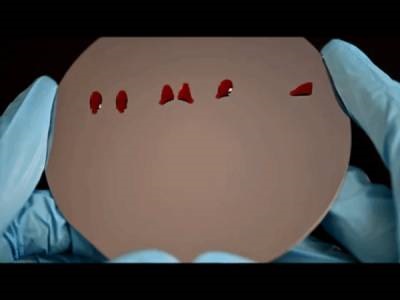
The coating is made up of two polymer brushes, one of which is more repellent than the other. The more repellent coating acts as a background to surround the less repellent coating, creating tiny channels along the surface. These channels allow the low surface tension liquids to be directed passively over a distance of more than 150 mm without the droplets collapsing, sticking to the surface or losing any volume. Because the design of the coating determines the pattern or direction of the fluid transportation, external forces such as magnetism and heat are not needed to move the droplets. The coating even allows the droplets to split and merge without any liquid being left behind and contaminating the channels. These results were published in Advanced Functional Materials.
“Polymer brush coatings reduce the fluid friction and allow the droplets to be transported passively,” said lead author Mohammad Soltani. “Less friction means more energy is available to transport the liquid. We then create a driving force by designing the channels with specific patterns.”
This new polymer coating could be a step forward toward more efficient and diverse diagnostic assays, including potential point-of-care devices. The researchers said the technology could reduce waste and cross-contamination due to no residue being left behind as the fluid is transported, and allow for better screening of biological markers that are typically analyzed in non-aqueous media.
Photo: New polymer coatings, developed by Professor Kevin Golovin and his team at the University of Toronto, show the precision with which liquids can move across surfaces. Credit: Mohammad Soltani, University of Toronto Engineering