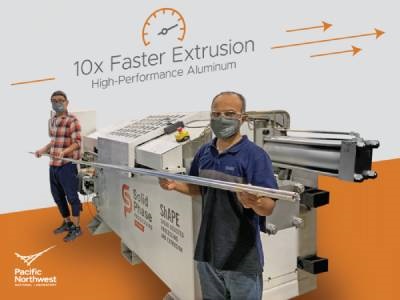
The use of lightweight materials, such as aluminum alloys, in vehicle manufacturing offers several benefits such as improved maneuverability and fuel efficiency. However, high-quality aluminum alloys can be costly, in part because extruding these materials into structural components can be a slow process using conventional methods. For example, aluminum alloy 7075, which has an 85% higher strength-to-weight ratio than more common 6000 series alloys, has a typical extrusion speed of just 1-2 meters per minute. Now, a new method developed by researchers at Pacific Northwest National Laboratory (PNNL) has opened up new possibilities for lightweight vehicle manufacturing by increasing the extrusion speed, lowering the costs and improving the mechanical properties of alloy 7075 structural materials.
The method, called Shear Assisted Processing and Extrusion (ShAPE), increases extrusion speed to about 12 meters per minute and can be performed at a relatively low temperature of 341°C, which saves energy and costs. The method involves rotating the metal billets in order to generate just enough heat through friction to soften the metal as it is pushed through a die. Removing the need for additional thermal treatment steps, such as preheating, results in energy savings of about 50%, according to the researchers.
Mechanical testing showed the resulting alloy 7075 components — including tubes, wire and bars — met or exceeded ASTM International standards and American Society for Metals (ASM) typical values. Additionally, components extruded through the ShAPE process showed a 50% greater elongation than those extruded through conventional processes, which can aid in energy absorption during a crash. Using lower temperatures than conventional processes not only conserved energy, but also prevented tearing of the material during extrusion, the researchers said. This study was published in the Journal of Manufacturing Processes.
“Extensive testing shows that PNNL’s process can increase the speed by about 1 times that of conventional extrusion for this alloy, using about half the energy,” said corresponding author Scott Whalen. “Our process can extrude about 12 meters per minute with no tearing or cracking, whereas conventional extrusion is limited to about 1 to 2 meters per minute—and our process even enhances some material properties.”
The ShAPE method is expected to help produce even lighter vehicles, reducing costs and carbon emissions both through increased fuel efficiency and better energy efficiency in the extrusion process itself. Making aluminum alloy 7075 more cost-effective and accessible in the passenger vehicle market can lead to an overall greener industry and cost savings for both manufacturers and consumers.
Photo: PNNL researchers Tian Wang (left) and Md. Reza-E-Rabby hold three-meter-long tubes that were extruded from aluminum alloy 7075 using the ShAPE process. Credit: Composite image by Cortland Johnson, Pacific Northwest National Laboratory