Proper microscope calibration is essential to ensure reproducibility in research and quality control applications, especially for highly sensitive systems such as those used in biology to study the structures and functions of cells. Imaging phantoms act as standards to ensure an imaging system can deliver the highest quality, repeatable results from analysis to analysis, but fluorescent phantoms that are stable, consistent and long-lasting can be hard to come by due to issues such as bleaching and fluorescence decay. Researchers at the University of Illinois Urbana-Champaign have now developed a new imaging phantom made from fluorescent nanodiamonds that offers increased reliability and longevity for continuous use in biological studies.
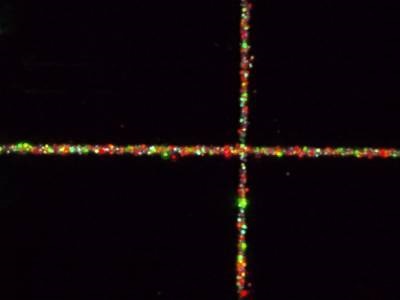
The new calibration tool consists of two 2D layers of nanodiamonds on glass coverslips; in one layer, the fluorescent nanodiamonds are randomly distributed, and in the other, the diamonds are embedded along a laser-etched viewfinder grid. The grid aids the user in locating the same areas on the imaging phantom for each calibration.
The researchers found that the nanodiamonds resisted bleaching and maintained a high fluorescence intensity after being stored for several months, with a less than 2% variation in intensity observed for individual particles between measurements. The long-term stability of the nanodiamond phantoms can aid researchers in ensuring accurate calibration for each observation across longitudinal experiments. This research was published in Photonics Research.
“There is potential that this is going to become a standard calibration tool in fluorescence microscopy worldwide. This sample is so convenient, and so easy to use, that it is hopefully going to make a large impact,” said Mantas Žurauskas, who led the research. “[They] are unique in the way that they do not bleach. Each time you look at them, they look the same. That’s very rare in fluorescence microscopy.”
Two industry partners are currently evaluating the new calibration tool to assess how it could improve their imaging systems for quality control and biomedical applications, Žurauskas said.
Photo: A microscopy image of the viewfinder grid with embedded nanodiamonds. Credit: Beckman Institute, University of Illinois Urbana-Champaign