MIT biologists showed, in a new study, that enlargement of blood stem cells restricts their ability to generate new blood cells during aging.
To study how size affects these stem cells, the researchers damaged their DNA, leading to an increase in their size. They then compared these enlarged cells to other cells that also experienced DNA damage but were prevented from increasing in size using a drug called rapamycin.
After the treatment, the researchers measured the functionality of these two groups of stem cells by injecting them into mice that had their own blood stem cells eliminated. This allowed the researchers to determine whether the transplanted stem cells were able to repopulate the mouse’s blood cells.
They found that the DNA-damaged and enlarged stem cells were unable to produce new blood cells. However, the DNA-damaged stem cells that were kept small were still able to produce new blood cells.
In another experiment, the researchers used a genetic mutation to reduce the size of naturally occurring large stem cells that they found in older mice. They showed that if they induced those large stem cells to become small again, the cells regained their regenerative potential and behaved like younger stem cells.
Until now, studying the function of cell size has been difficult to do, says Jan Skotheim, a professor of biology at Stanford University.
When the researchers treated mice with rapamycin, beginning at a young age, they were able to prevent blood stem cells from enlarging as the mice got older. Blood stem cells from those mice remained small and were able to build blood cells like young stem cells even in mice 3 years of age — an old age for a mouse.
Rapamycin, a drug that can inhibit cell growth, is now used to treat some cancers and to prevent organ transplant rejection, and has raised interest for its ability to extend lifespan in mice and other organisms. It may be useful in slowing down the enlargement of stem cells and therefore could have beneficial effects in humans.
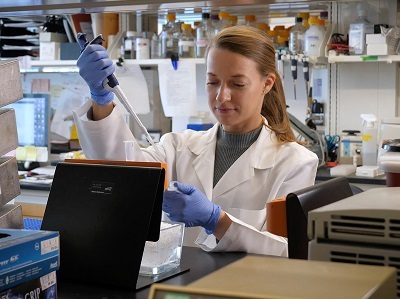
Photo: Jette Lengefeld, a former postdoc in the lab of MIT Professor Angelika Amon. Credit: Raleigh McElvery and Sebastian Swanson