Non-line-of-sight (NLoS) imaging is an emerging research field centered on technology that can visualize objects hidden behind occlusions, such as walls, or scattering media, such as skin or tissue. One way to do this is to indirectly illuminate an occluded object using an intermediary source such as another nearby wall, but it is difficult to reconstruct a holographic image using the scattered and redirected light without having access to extremely fast detectors. To make NLoS imaging more practical for applications such as medical diagnostics and road safety, researchers at Northwestern University have developed a system that does not require ultrafast detectors but instead uses synthetic wavelengths to more easily and accurately reconstruct holograms of the obscured objects.
The synthetic wavelengths are created by directing two very similar wavelengths at an intermediary object. These two wavelengths follow nearly identical and correlating paths as they strike the intermediary object, indirectly illuminate the hidden object, scatter back toward the intermediary and then lastly toward the sensor system. Although only a small portion of the original light makes it back to the detector, the image can be reconstructed computationally by combining information from these two similar and correlating wavelengths. Objects obscured behind scattering media can also be reconstructed by directing the synthetic wavelengths into the media.
This method, called synthetic wavelength holography, was used to reconstruct images of small objects shaped like the letters “N” and “U.” In experiments testing the system’s ability to look around corners and through scattering media, including a ground glass diffuser and milky white plastic, the shapes of the letters could be reconstructed with sub-millimeter resolution. The synthetic wavelengths can be tuned to produce the clearest image in certain situations; for example, longer wavelengths resulted in clearer images than shorter wavelengths when imaging a target through milky plastic. The technique can use any opaque object as a virtual source of illumination, such as a wall, shrub or vehicle, making it a potentially valuable tool for producing vehicle sensors that can warn drivers of obstructions that are just out of sight. This research was published in Nature Communications.
“It’s like we can plant a virtual computational camera on every remote surface to see the world from the surface’s perspective,” said first author Florian Willomitzer. “This technique turns walls into mirrors. It gets better as the technique also can work at night and in foggy weather conditions.”
Other potential applications of this technology are medical and industrial imaging. Synthetic wavelength holography can provide a less invasive method for seeing behind skin and tissue or for looking deep inside the intestines for a colonoscopy. And because the synthetic wavelengths could even image objects that are in motion, they could also be used to probe the internal workings of industrial equipment, such as turbines, while they are still operating.
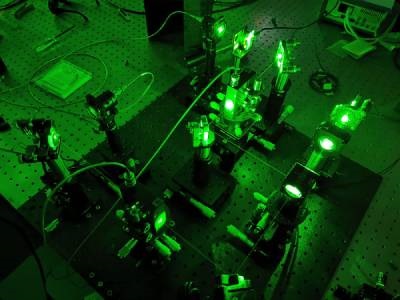
Photo: A setup of one of the camera prototypes in the laboratory. Credit: Florian Willomitzer, Northwestern University