Incredible strides have been made in the advancement of DNA sequencing technology over the last couple decades; sequencing of an entire human genome, a feat that once took several years to complete, can now be done in just a few days or even hours. Now, that timeframe has grown even shorter, as a new method developed at Stanford Medicine has recently set the world record for fastest DNA sequencing technique.
The Stanford scientists were able to sequence one patient’s genome in just 5 hours and 2 minutes, and provide a diagnosis in 7 hours and 18 minutes, earning them the official Guinness World Records title; the record was also certified by the National Institute of Science and Technology’s Genome in a Bottle group. The previous record for fastest genome sequencing-based diagnosis was about 14 hours, which was achieved by the Rady Children’s Institute. Over the span of six months, the Stanford team used their advanced methodologies to sequence the genomes of a total of 12 patients and diagnosed five patients with an average time-to-diagnosis of 8 hours. The results of the study were published in The New England Journal of Medicine.
The super-fast technique relies on impressive hardware and computer power, as well as the cooperation of team members who put in every effort to hasten the process while maintaining accuracy, according to the university. The team utilized an instrument from Oxford Nanopore Technologies composed of 48 flow cells, which were all used simultaneously for one person’s genome. A method was developed to funnel the immense amount of data efficiently into a cloud-based storage system, and algorithms were used to scan the genetic code for disease-causing errors in real time. Long-read sequencing was used to ensure a thorough analysis that could lead to confident and accurate diagnosis for each patient.
“Mutations that occur over a large chunk of the genome are easier to detect using long-read sequencing. There are variants that would be almost impossible to detect without some kind of long-read approach,” explained Euan Ashley, a professor of medicine, genetics and biomedical data science at Stanford, who helped lead the project. “That was one of the big reasons we went for this approach.”
One of the patients who was enrolled in the study was a 3-month-old infant suffering from seizures who was diagnosed in just over eight hours after a mutation in their CSNK2B gene was discovered. Another patient, a 13-year-old boy, was on life support due to heart failure when the genome sequencing technique revealed that his myocarditis had a genetic cause. The patient was immediately put on a heart transplant list and received a new heart 21 days later. Stanford researchers highlighted these cases to demonstrate how receiving fast, accurate answers about genetic diseases can make a difference for patients and their families.
“Genetic tests just aren’t thought of as tests that come back quickly. But we’re changing that perception,” Ashley said.
The team hopes to optimize the system even further, and believe they could even cut the current sequencing time in half, Ashley said.
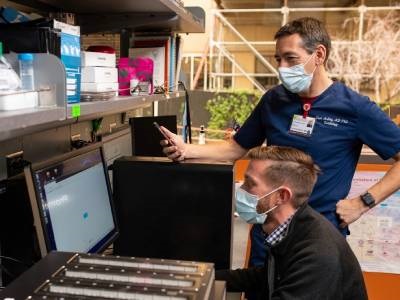
Photo: Euan Ashley (standing) and John Gorzynski were part of a team that devised a method for genome sequencing so speedy it produced results for one study participant in just over five hours. Credit: Steve Fisch