The number of cycles it takes to amplify DNA sequences of interest so that they are detectable by the PCR machine, known as the cycle threshold (Ct), is what researchers and medical professionals look at to detect SARS-CoV-2.
However, not all labs get the same Ct values (sometimes also called “Cq” values). In efforts to make the results more comparable between labs, the National Institute of Standards and Technology (NIST) contributed to a multiorganizational study that looked at anchoring these Ct values to a reference sample with known amounts of the virus.
For this study, a multiorganizational research team set out to explore how much Ct values could vary among different labs when they ran PCR tests on the same reference samples containing known amounts of the SARS-CoV-2 virus. Two reference materials with carefully measured concentrations of the SARS-CoV-2 RNA were developed by a group of organizations and institutions led by INSTAND, an interdisciplinary scientific society in Germany that promotes quality assurance in medical laboratories. RM 1 had an estimated viral load of 10 million (107) copies per milliliter, and RM 2 had an estimated viral load of one million (106 ) copies per milliliter.
To ensure these values were accurate, three national metrology institutes — the UK National Measurement Laboratory for Chemical and Bio-Measurement (LGC), Physikalisch-Technische Bundesanstalt (PTB, in Germany) and NIST—measured and validated the reference materials using digital PCR.
The reference materials were sent out to a total of 305 laboratories in Germany, which yielded 1,109 data sets to be analyzed. The Ct values differed between labs depending on the test system or PCR equipment used and the targeted DNA sequences of the virus. For example, PCR assays aiming to detect a key gene (the “N” gene) in the COVID-19 virus had a range of Ct values between 17.6 and 26.9 for RM 1, while for RM 2 the range was between 20.7 and 30.1. The ranges between the two RMs overlap (20.7 to 26.9) even though they have different viral load concentrations, which shows it’s not possible to tell the precise concentration from Ct values alone, said Cleveland.
The differences in Ct values among labs showed the usefulness of reference materials as a tool to help labs compare and standardize their results.
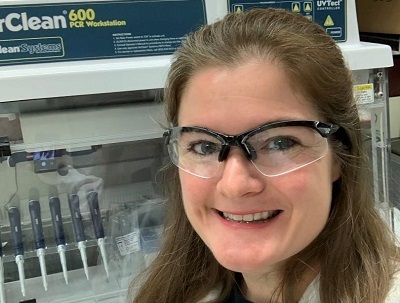
Photo: NIST researcher Megan Cleveland uses a PCR machine to amplify DNA sequences by copying it numerous times through a series of chemical reactions. Credit: M. Cleveland/NIST