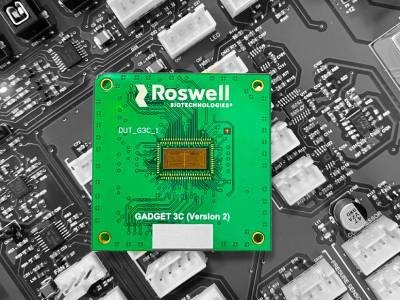
Single molecules are one of the smallest building blocks of our universe and serve important and unique functions, including biological functions that are vital to life. Because of their small size, individual molecules are difficult to observe and track except through indirect methods such as fluorescent labeling. Now, researchers from the University of California-San Diego, Rice University, Harvard Medical School and Roswell Biotechnologies have taken a new approach using single molecules to study single molecules, incorporating these tiny building blocks into electronic semiconductor chips to produce highly sensitive, programmable and scalable biosensors.
The novel platform developed by the researchers consists of a programmable semiconductor chip with a scalable sensor array architecture. Each array element includes an electric current meter used to monitor the current flowing through a precisely engineered molecular wire spanning a tiny gap of approximately 20 nm between nanoelectrodes, which couple it directly into the circuit. The wire itself is made from a 25-nm-long α-helical peptide and is engineered with a central conjugation site where the desired probe molecule can be attached in order to directly interact with the molecule of interest. The current meters measure the pico-amp scale electrical activity produced by interactions between the probe and target molecule, and current-versus-time measurements are provided as a real-time digital readout at a rate of 1000 frames per second, providing high-resolution data about the molecular interactions.
The conjugation site incorporated on the molecular wire can accommodate a wide range of probe molecules, including DNA, aptamers, antibodies and antigens, making the platform highly customizable for a variety of applications such as drug discovery, proteomics and diagnostic testing, including rapid COVID-19 testing. The sensors are also capable of reading DNA sequences using a DNA polymerase probe. The activity signals of the enzyme as it copies nucleotides one-by-one can be analyzed via machine learning algorithms in order to determine the sequence of the DNA being replicated. This research was published in the Proceedings of the National Academy of Sciences.
“The Roswell sequencing sensor provides a new, direct view of polymerase activity, with the potential to advance sequencing technology by additional orders of magnitude in speed and cost,” said George Church, a co-author of the paper, member of the National Academy of Sciences, Roswell Scientific Advisory Board member and professor of genetics at Harvard Medical School. “This ultra scalable chip opens up the possibility for highly distributed sequencing for personal health or environmental monitoring, and for ultra-high throughput applications such as Exabyte-scale DNA data storage.”
This on-chip platform also has a durable, long-term scaling roadmap with unlimited possibilities for further miniaturization and performance improvements as semiconductor chip technology continues to advance, the researchers wrote.
Photo: The Roswell Molecular Electronics Chip™️, the first scalable molecular electronics chip, uses single molecules as universal sensor elements in a circuit to create a programmable biosensor with real-time, single-molecule sensitivity and unlimited scalability in sensor pixel density. Credit: Roswell Biotechnologies