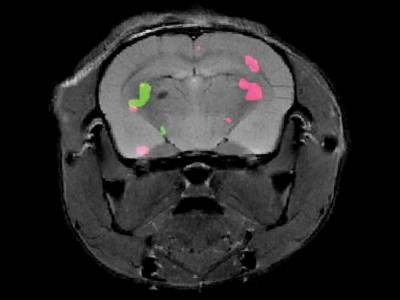
Fluorescent probes are commonly used to track gene expression using fluorescence microscopy; however, this method runs into limitations when it comes to tracking what goes on in the deep tissues of the body. Unlike microscopy, magnetic resonance imaging (MRI) allows structures deep inside the body to be observed, but typically produces grayscale images that don’t provide specific information about gene expression. Now, researchers at the Weizmann Institute of Science have combined the utility of reporter probes with the technology of MRI to produce a system that allows two genes to be tracked simultaneously on a dual-color MRI map.
The researchers designed two novel probes made from synthetic deoxyribonucleosides that are MRI-detectable, unlike conventional fluorescent probes that can have their signal blocked behind thick tissues. These reporter probes are paired with two engineered reporter genes that encode orthogonal enzymes to which the reporter probes exclusively accumulate, ensuring expressions of the reporter genes can be tracked through the signal of the probes. The two different probes are designed to issue signals in response to different MRI frequencies, producing a different color on the MRI map that is produced.
Using extremely powerful MRI equipment with a magnet of about 15 tesla, the team performed scans on live mice, revealing the exact positions of cells expressing the engineered proteins in green and pink - a different color for each gene. Whereas previous efforts to use MRI technology to detect gene expression could only track one gene at a time, the new method, which the researchers call GeneREFORM, can track two genes simultaneously, providing new opportunities to monitor biological processes in deep tissues similarly to how fluorescent labeling is used in microscopy. This research was published recently in Nature Biotechnology.
“Gene expression lets us know what each cell is doing. Thanks to our method, MRI may now be applied by researchers in various fields to track the activity of all kinds of processes, for example, those involving different types of brain or immune cells,” said first author Hyla Allouche-Arnon.
If this technology is one day adapted for use in humans, it could be used to noninvasively monitor biological processes in deep tissues, such as in the tracking of progress of cell therapies for cancer.
Photo: Two different proteins expressed in a mouse brain are revealed by dual-color MRI. Credit: Weizmann Institute of Science