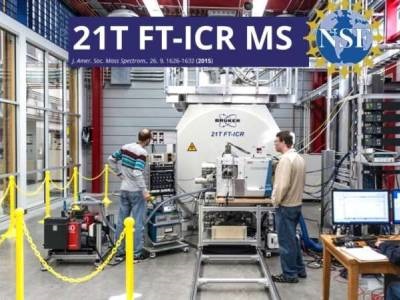
Per- and polyfluoroalkyl substances (PFAS), sometimes called “forever chemicals” due to their persistence in the environment, come in thousands of different forms, many of which have not been fully identified or characterized. While only about 15-30 of these substances are tested regularly, a larger repository of information covering a much wider range of PFAS compounds is needed to better understand the potential health and environmental risks of these chemicals, and how to better study and manage them. Researchers at the University of Colorado are working to build a comprehensive library of PFAS, including new insights and previously undiscovered compounds, using the one-of-a-kind 21 tesla Fourier-transform ion cyclotron resonance mass spectrometer (21T FT-ICR MS) at the National High Magnetic Field Laboratory (MagLab) in Tallahassee, Florida.
The 21T FT-ICR MS system offers ultra-high resolution without the need for chromatographic separation and is capable of resolving 10s of thousands of compounds in a sample with as little as sub-ppm error across a wide molecular weight range. The resolving power of this unique system is orders of magnitude higher than that of other techniques like quadrupole time-of-flight (QToF) and Orbitrap MS, opening up new possibilities for non-targeted screening of PFAS in complex samples.
The researchers developed a method for suspect and nontarget screening of PFAS using the MagLab system, and identified 163 known PFAS as well as 134 novel PFAS in samples of aqueous film-forming foam (AFFF), a type of firefighting foam used to extinguish flammable liquids like oil. The team also used the 21T FT-ICR MS system to analyze AAAF-contaminated samples containing as many as 30,000 different compounds, including mixtures of human-made chemicals and natural organic material. The resolving power of the 21T FT-ICR MS system allows the researchers to determine the elemental makeup of many of these compounds and identify where PFAS may lurk among the other components. The team’s most recent paper, “PFAS Analysis with Ultrahigh Resolution 21T FT-ICR MS: Suspect and Nontargeted Screening with Unrivaled Mass Resolving Power and Accuracy,” was published recently in Environmental Science & Technology.
While the MagLab 21T FT-ICR MS is the only one of its kind, and thus of limited availability, the University of Colorado team aims to make the information they’ve gained from their use of the system accessible to other scientists through their building of a comprehensive PFAS library and database. With access to this new information about previously uncharacterized substances and mixtures, scientists around the world can conduct further research into topics such as health and safety effects, chemical interactions and transportation of these substances throughout the environment.
“We want to leverage the power of ion cyclotron resonance to provide a service to the scientific community by establishing a catalog of PFAS compounds they can use as a tool to develop methods that don’t rely on 21T FT-ICR MS,” said study co-author Amy McKenna.
“The long-term goal is to help identify these things so other people know what to look for,” added first author Robert Young. “As soon as we know what to look for, we can focus on understanding the health and environmental impacts, and prioritize treatment or regulatory solutions.”
Photo: The 21 tesla Fourier-transform ion cyclotron resonance mass spectrometer (21T FT-ICR MS) at the NSF-funded National High Magnetic Field Lab is the most powerful, highest resolving machine of its kind. It uses electric and magnetic fields to distinguish individual molecules and can differentiate between chemical compounds more accurately than any other instrument. Credit: Colorado State University