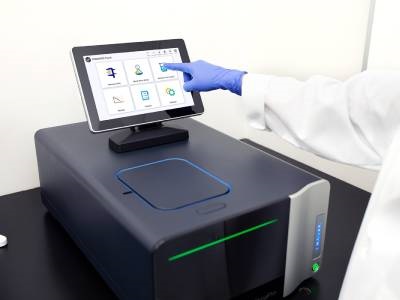
A recently launched dynamic light scattering (DLS) system from Wyatt Technology allows walk-up measurements of proteins, polymers and nanoparticles using an on-board app and large touchscreen display. The DynaPro Nanostar II, announced this month, utilizes the fully integrated DYNAMICS Touch software to enable walk-up operation without the need for a constant connection to computer systems or external software. The full-size touch screen also provides instructions to guide the user through setup and measurement processes and instantly displays results.
DYNAMICS Touch performs automated data quality assessments allowing users to troubleshoot issues that may have led to poor measurements, according to Wyatt Technology. Data files and PDF files can be stored on the DynaPro Nanostar II instrument, transferred via the network, downloaded to a flash drive or transmitted to mobile devices. Data can further be imported to Wyatt’s full DYNAMICS software package for Windows, which includes comprehensive collection, analysis and reporting capabilities for DLS and static light scattering in compliance with 21 CFR Part 11 security standards.
The DynaPro Nanostar II accommodates 2 μL quartz cuvettes and 4 μL disposable microcuvettes for the analysis of samples including proteins, gene therapy vectors, viruses and virus-like particles, promiscuous inhibitors, micelles, liposomes, lipid and metallic nanoparticles and more. Paired with the DYNAMICS and DYNAMICS Touch software, the instrument can be used to measure size, size distributions, particle concentration and weight-average molar mass, as well as further solution properties relevant to sample stability such as second virial coefficient (A2 or B22), diffusion interaction parameter (kD), and temperature of protein melting or aggregation onset (Tm, Tonset).
Wyatt’s quartz cuvettes can be used with as little as 2 μL sample, aqueous or organic solvents, over an extended temperature range from -10 °C to +120 °C. The company’s disposable cuvettes require only 4 µL of sample, aqueous or select polar solvents, with larger-volume quartz and disposable cuvettes also available. The molecular weight range of the DynaPro Nanostar II is 300 Da to 1MDa with a particle size (hydrodynamic radius) range from 0.2 to 1000 nm.
“I’m delighted about the number of early adopters of the NanoStar II,” said Wyatt Technology CEO Geofrey Wyatt, in a statement. “The ‘Holy Grail’ of analytical instrumentation is to make the customer experience a positive one. Our DYNAMICS® TouchTM software running on a beautiful touch-screen comes as close as I’ve ever seen to this prize!”
In addition to the DYNAMICS software package, the NanoStar II can also be coupled with any of Wyatt’s on-line MALS detectors, such as the DAWN or miniDAWN, to add on-line DLS measurements in the same detection volume as SEC-MALS or FFF-MALS measurements.