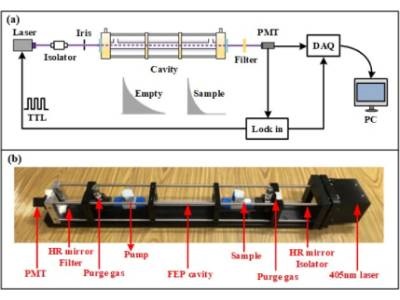
Nitrogen dioxide (NO2) is a highly reactive gas and source of environmental pollution, which can react with water and oxygen to form acid rain, among other adverse effects. The role of NO2 in atmospheric pollution poses the need for increasingly sensitive and accurate measurement tools for monitoring and studying NO2 levelsin the environment. Researchers at the Hefei Institutes of Physical Science (HFIPS) at the Chinese Academy of Sciences (CAS) have now developed a novel NO2 detection system that offers extreme sensitivity and precision down to 8 parts per trillion by volume (pptv), while also being easy-to-use with low maintenance needs, offering new possibilities for environmental monitoring and scientific research.
The team’s method is referred to as Amplitude Modulated multimode-diode-laser-based Cavity Enhanced Absorption Spectroscopy (AM-CEAS) and involves the application of an amplitude modulation technique to a multimode diode laser. The laser was TTL-modulated at 35 kHz and operated at 406 nm, using phase-sensitive detection to enable ultra-sensitive absorption measurement. The system integrates the advantages of high light injection efficiency, low cavity-mode noise and narrow-bandwidth weak signal detection into one system to achieve the highest possible sensitivity and precision for measuring absorption, the authors wrote.
The AM-CEAS system was able to achieve a detection precision of 35 pptv in a 1 second data acquisition time and 8 pptv in a 30 s acquisition time. The AM-CEAS measurements were more than four times more precise than those made using a Cavity Ring-Down Spectroscopy (CRDS) method on the same instrument, the researchers reported. Additionally, combined with ring-down time measurement, the AM-CEAS technique can eliminate the calibration process of mirror reflectivity. Overall, the AM-CEAS system offers a simple, self-calibrating, low-maintenance and relatively inexpensive solution for ultrasensitive NO2 detection with long-term stability and reliability, according to the researchers. This study was published in Analytical Chemistry.
The newly-developed AM-CEAS instrument is currently being used for comprehensive field observation at an urban site in Beijing, and was also used to measure atmospheric totals of reactive nitrogen during the Beijing 2022 Olympic Winter Games.
Photo: Schematic diagram of the experimental setup of the AM-CEAS instrument. Credit: Zhou Jiacheng