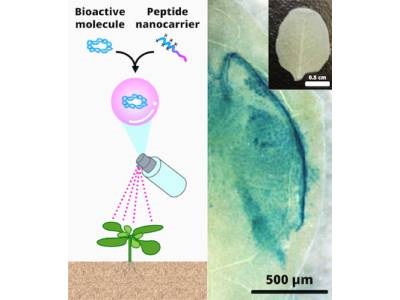
Genetic modification of plants can produce more robust crops such as varieties that are more resistant to pests or that can better survive drought. However, producing transgenic plants by directly altering the genome can be both an expensive and a time consuming process. Researchers at the RIKEN Center for Sustainable Resource Science (CSRS) have proposed a new, simpler way to improve crop properties, using a bioactive spray that alters gene expression on the fly without the need to develop a new transgenic line.
The gene modulating spray consists of bioactive molecules such as DNA or RNA attached to peptide nanocarriers, specifically cell-penetrating peptides (CPPs) that can both pass through cell walls and target specific structures like chloroplasts. The RIKEN CSRS team screened several different natural and synthetic CPPs to determine which would be best suited for the spray, tagging the nanocarriers with fluorescent yellow reporters and spraying them on the leaves of Arabidopsis thaliana, soybean and tomato plants. The amount of fluorescence in the leaves was measured using confocal laser-scanning microscopy at different points in time, and several natural CPPs were identified that were able to penetrate into the outer layers of the leaves or deeper.
Combining the best CPPs with plasmid DNA and applying them through an aqueous spray proved effective for expressing specific genes in the leaves of A. thaliana and soybeans. By including additional biomolecules and nanostructures, the researchers could also increase the number of pores in the leaves temporarily in order to increase uptake of the spray by the plant. The team also tested the use of RNA with the CPP spray to suppress gene expression, creating a transgenic plant that overexpresses yellow fluorescence and spraying on an RNA sequence that interferes with fluorescent protein expression. The CPP-RNA complex was able to silence the yellow fluorescence expression, and the researchers could similarly silence genes specific to chloroplasts by including a chloroplast-targeting peptide in subsequent experiments. This research was published in ACS Nano.
“Mitochondria and chloroplasts regulate much of a plant’s metabolic activity. Targeting these structures with bioactive molecules delivered via spray could effectively improve economically desirable quality traits in crops,” said Masaki Odahara, who led the research team. “Our next step is to improve the efficiency of the delivery system. Ultimately, we hope this system can be used to safely protect crops from parasites or other harmful factors.”
Photo: (Left) Schematic of the process. A bioactive molecule (like DNA or RNA) is combined with a peptide nanocarrier (a cell-penetrating peptide, CPP) in an aqueous solution and then sprayed onto plant leaves with a spray atomizer. This technique can alter gene expression without altering the genes themselves. (Right) Evidence that the system can be used to promote gene expression. Blue staining can be seen after spraying with a plasma DNA/CPP complex containing the GUS reporter gene. Note the upper leaf without any blue staining. This leaf was sprayed with a solution that contained the plasma DNA but not the peptide carrier. Credit: RIKEN