CRISPR-Cas9 gene editing is a powerful technique with many benefits in life science research, but also comes with challenges such as the occurrence of off-target cleavage. These types of errors can occur when Cas9 activates and begins cleaving mismatched DNA that differs from the intended target by just a small number of nucleotides. Researchers at the University of Texas at Austin have now discovered a mechanism that allows Cas9 to cleave these mismatched sequences, and have designed a new version of the protein to disrupt this mechanism and reduce errors.
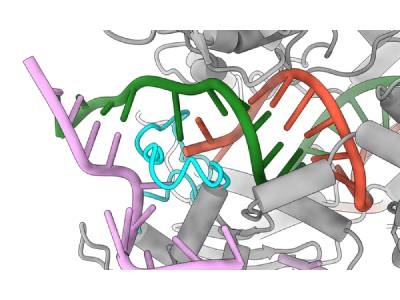
The researchers used a technique they developed called kinetics-guided structural determination, in which kinetics analyses of Cas9 were used to inform sample preparation for cryogenic electron microscopy (cryo-EM). The team tracked the rates at which Cas9 cleaved sequences with mismatched nucleotides at different positions, then examined the structure of Cas9 in complex with mismatched DNA substrates by freezing the samples at different time points. The kinetics-guided cryo-EM observations revealed that when three mismatched nucleotides appear 18-20 base pairs distal from the protospacer adjacent motif (PAM), the RuvC domain of Cas9 interacts with the mismatched DNA in a way that stabilizes it and allows cleavage to resume as though the sequence was actually correct. According to co-senior author David Taylor, this mechanism involving the RuvC domain has not been observed before and was completely unexpected.
Using the insights gained from their cryo-EM and kinetics experiments, the team then developed a redesigned Cas9 protein that mutates the residues involved stabilizing mismatched DNA by replacing them with aspartic acid. Rather than stabilizing the mismatched sequences and facilitating off-target cleavage, the new version, dubbed SuperFi-Cas9, pushes the RuvC domain away from the DNA and prevents further cleavage in the case of a mismatch. The researchers reported that their redesigned protein not only reduces errors, but also allows on-target cleavage to occur at a similar rate to wild-type Cas9, whereas previous efforts to reduce errors have typically sacrificed speed and efficiency. This research was published in the journal Nature.
“This really could be a game changer in terms of a wider application of the CRISPR Cas system in gene editing,” said co-senior author Kenneth Johnson.
In order for CRISPR-Cas9 technology to be used for therapeutic applications, errors such as off-target cleavage must be minimized in order to ensure the method can be applied safely, the authors wrote. Improved versions of the Cas9 protein, such as SuperFi-Cas9, offer new opportunities to expand these applications. The researchers noted that SuperFi-Cas9 has so far been tested on DNA isolated in test tubes, and they are now collaborating with other researchers to further test its use for gene editing in living cells.
Photo: The researchers were surprised to discover that when Cas9 encounters a mismatch in a certain part of the DNA (red and green), instead of giving up and moving on, it has a finger-like structure (cyan) that swoops in and holds on to the DNA, making it act as if it were the correct sequence. Credit: Jack Bravo/University of Texas at Austin