The “handedness” of chiral biomolecules found in pharmaceuticals and nutritional supplements is an important factor in their safety and quality, as different enantiomers can have different effects in the body. While many techniques used for quality control of these substances are highly sensitive to impurities such as heavy metals and residual solvents, chiral impurities are more difficult to detect due to the structural similarities between enantiomers. A team led by researchers at the University of Michigan (U-M) have now demonstrated the potential of terahertz radiation to help monitor chiral structures in drugs and supplements via circular dichroism spectroscopy.
The researchers tested whether terahertz circular dichroism (TCD) spectroscopy could be used to generate and measure chiral phonons in different biomolecules; chiral phonons are “twisting” vibrations that are highly sensitive to the structures and nanoscale assemblies of molecules, providing a “fingerprint” of different chiral structures, explained co-corresponding author Nicholas Kotov. Specifically the team studied the terahertz chiroptical properties of amino acid biocrystals, as all amino acids are available as left/right enantiamoters, and amino acids also have strong absorptions bands in the terahertz range, the authors wrote. Because the radiation in the experiment is circularly polarized in a specific direction, chiral phonons of different directions can result in distinct terahertz spectral readings.
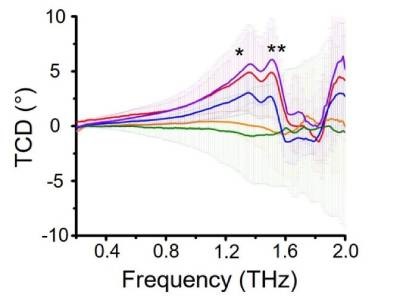
The researchers found that while the standard terahertz absorptions spectra of L- and D-enantiomer amino acids were almost identical, the spectra obtained using TCD spectroscopy showed distinct, mirror-symmetrical peaks. The team further used the technique to measure the phonons of L-carnosine, an enantiomer commonly used as a nutritional supplement, and identified differences in the chiral phonons of supplements from different manufacturers. They also used it to study the development of amyloid fibrils in insulin, which can cause it to become inactive. The researchers found that the intensity of the TCD spectra increased dramatically as the fibrils formed, showing the technique could potentially be used to assess insulin quality as well. Furthermore, the intense vibrations and twisting motions induced in many biomolecules when excited by terahertz radiation suggests the technique could even be used to influence their structures in addition to measuring them, expanding its applications. This research was published in Nature Photonics.
“We foresee new roads ahead–for instance using terahertz waves with tailored polarization to manipulate large molecular assemblies. It might replace microwaves in many synthesis applications in which the handedness of the molecules matters,” said co-corresponding author André Farias de Moura, of the Federal University of São Carlos, which collaborated with U-M on the project.
Another potential application of TCD is rapid diagnostics for both animals and humans, as conditions such as bladder stones, kidney stones and Alzheimer’s involve the build up of certain chiral molecules in the body. For example, the researchers were able to use TCD to identify spectral signatures of L-cystine in canine bladder stones.
Photo: This graph shows the terahertz circular dichroism spectra of five different brands of L-carnosine. While three samples show the same pattern of peaks, the measurement suggests possible differences from the remaining two samples. Credit: Wonjin Choi, Kotov Lab, University of Michigan