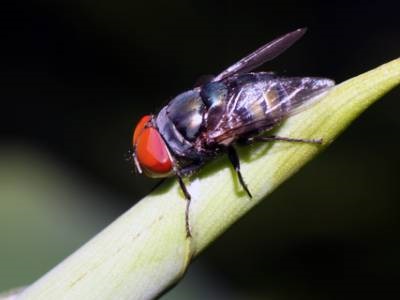
Chemical weapons pose a serious threat and have been deployed in recent conflicts such as the Syrian civil war, despite widespread bans on their use; some experts now fear these weapons are being used in the war in Ukraine. Investigating the use of chemical warfare agents is a difficult and dangerous task with few safe alternatives that would reduce the risk of toxic exposure; these investigations may also be limited by the inability to access restricted or remote sites where these chemicals might be present. Researchers from the School of Science at Indiana University-Purdue University Indianapolis (IUPUI) have now shown that blow flies, ubiquitous insects in many environments, can be used as natural samplers of chemical warfare agents, storing the chemicals for long periods in their gut that can then be analyzed via liquid chromatography-tandem mass spectrometry (LC-MS/MS).
Blow flies frequently explore their environment by “tasting” everything around them, and information about where they’ve been or what they’ve encountered ends up stored in their gut through this process, explains Christine Picard, an associate professor of biology and director of the Forensic and Investigative Sciences Program at IUPUI. The researchers tested whether chemical weapon simulants–substances with similar features to chemical weapons but that are not poisonous to humans–could similarly be stored and detected in the guts of blow flies, and how long after exposure the simulants could be detected in the flies. Different temperature and humidity conditions were used as factors in the experiment.
The study found that, despite the fact that chemical warfare agents typically do not persist for long in the environment, the simulants could still be detected in the flies 14 days following exposure. The researchers were also able to detect a hydrolysis product of sarin, as well as the pesticide dichlorvos, using LC-MS/MS 14 days after exposure. This shows that not only can the flies be used as remote samplers for chemical weapons themselves, but can also show where a chemical agent has broken down and hydrolyzed in water, and could be used in additional applications to detect the presence of pesticides and other pollutants in the environment. This research was published recently in Environmental Science and Technology.
“If an area is too dangerous, too remote or in an access-restricted area – or if one just wanted to collect samples covertly – then one just needs to put out some bait and the flies will come to the bait,” said Nick Manicke, an associate professor of chemistry, chemical biology, and forensic and investigative sciences at IUPUI.
The research team now plans to apply the insights from this study toward a new two-year project funded by the Army Research Office on Environmental Chemistry. This project will focus on the detection of molecules from “insensitive munitions,” a new class of explosive compounds that are less likely to detonate on accident but tend to deposit more into the environment.