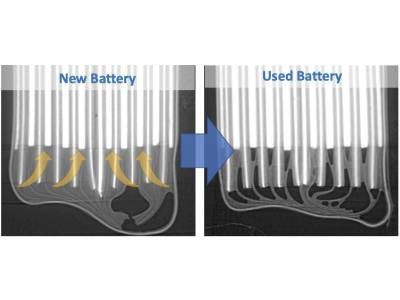
Advancements in electric vehicles and aircraft require lightweight, high-capacity and long-lasting batteries to ensure reliable operations and reduce interruptions and costs from replacing degraded batteries. Batteries with high energy density tend to degrade more quickly due to physical damage, as electrode materials undergo more dramatic expansion and shrinking through multiple charge/discharge cycles. To better understand this damage over time, and gain insights for designing more resilient batteries, researchers at the Canadian Light Source synchrotron facility performed detailed computed tomography (CT) scans on different types of lithium ion (Li-on) cells.
Microcracks that gradually form as lithium ions are forced in and out of electrode materials over multiple cycles are often examined through electron microscopy, but this requires taking the battery apart and destroying it. CT imaging allows the larger structure of the battery to be preserved so the effects of the damage on every part of the battery can be viewed in full context. The study included three different types of cells, including one made from polycrystalline material and two made from single-crystal material, that were continuously cycled for more than two years, as well as controls that had never been used. For each type of cell, different cycling conditions were used for different groups of samples to study the effects of factors like depth of discharge (DoD) and C-rate. The damage to the cell material was examined and compared between the different cell types and conditions with the aid of 3D renderings and 2D cross sections produced from the CT images.
The CT images allowed the researchers to observe, at microscopic scale, the effects of physical degradation over many cycles, including how liquid electrolyte was pulled into the extra space left between microcracks. The team also found that cells discharged to a lower DoD showed less deterioration than those discharged to 100% DoD, likely because a smaller change in charge causes less physical strain on electrode material over time, according to the researchers. These insights are key when considering batteries used in new applications such as electric long-haul transport, electric aircraft flights and the use of electric vehicles to store and deliver energy into the electrical grid, where higher DoDs can be expected between recharges. This research was published in the Journal of the Electrochemical Society.
“This is the first time anyone’s been able to capture all of these effects happening together in a working battery. This depletion of liquid electrolyte can cause serious problems, since any part of the battery that doesn’t get enough liquid would essentially stop working,” said first author Toby Bond. “... As we start replacing more and more combustion-driven vehicles with electric vehicles, it’s really important to understand how batteries will behave under different conditions. It’s very exciting to work on these problems, and we really need tools like synchrotrons to understand the fine details of what’s going on inside the battery when we try out new approaches.”
Photo: Canadian Light Source CT scans reveal that electrolyte liquids inside the battery are sucked into the expanded pore space created by microcracked positive electrode materials. Credit: Canadian Light Source