Doctors warn that marijuana use during pregnancy may have harmful effects on the development of a fetus, in part because the cannabinoid receptors activated by the drug are known be critical for enabling a developing brain to wire up properly. Now, scientists at MIT’s McGovern Institute for Brain Research have learned that cannabinoid receptors’ critical role in brain development does not end at birth.
In an online issue of eNeuro, scientists led by McGovern investigator Ann Graybiel report that mice need the cannabinoid receptor CB1R to establish connections within the brain’s dopamine system that take shape soon after birth.
While investigating the receptor’s distribution in the brain, the researchers discovered that in the adult mice, CB1R is abundant within small compartments within the striatum called striosomes. The receptor was particularly concentrated within the neurons that connect striosomes to a dopamine-rich area of the brain called the substantia nigra, via structures that Graybiel’s team has dubbed striosome-dendron bouquets.
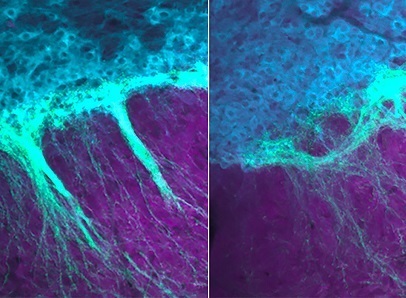
By tracking the bouquets’ emergence in newborn mice, Graybiel’s team found that they form in the first week after birth, a period during which striosomal neurons are ramping up production of CB1R. Mice genetically engineered to lack CB1R, however, can’t make these elaborate but orderly bouquets. Without the receptor, fibers from striosomes extend into the substantia nigra, but fail to form the tightly intertwined “bouquet stems” that facilitate extensive connections with their targets. This disorganized structure is apparent as soon as bouquets arise in the brains of young pups and persists into adulthood.
“This is a real change to one of the truly important systems in the brain—a major controller of our dopamine,” says Graybiel, who is an Institute Professor and a faculty member in the Department of Brain and Cognitive Sciences.
Now that the researchers have shown that CB1R is needed for postnatal brain development, it will be important to determine the consequences of disrupting cannabinoid signaling during this critical period—including whether passing THC to a nursing baby impacts the brain’s dopamine system.
Photo: Cannabinoid receptor 1, the cell-surface receptor that mediates the psychoactive effects of marijuana, is essential for normal development of the dopamine system. Images of the midbrain show that dopamine-producing neurons (light blue) extend dendrites that are tightly bundled with input axons from striosomes (co-labeling shown in bright green) in normal mice (left), but that these structures are malformed in knockout mice that lack cannabinoid receptor 1 (right). Credit: Jill R. Crittenden, Ara Mahar, and Tomoko Yoshida