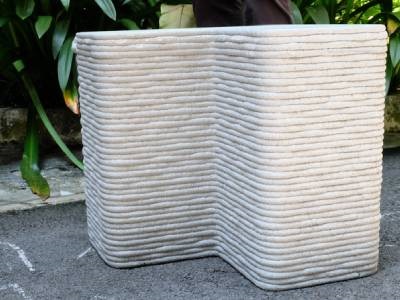
3D printing of concrete is becoming more popular due to advantages such as greater design flexibility, lower costs and reduced waste compared to traditional construction approaches. A major component of concrete is sand, which is extracted from areas like riverbanks and beaches; however, this extraction process can be harmful to the environment, and many areas are now facing shortages of this important natural resource. Researchers at Nanyang Technological University in Singapore (NTU Singapore) have now tested a potential alternative to sand in 3D-printable cement materials, using recycled glass to print concrete benches with favorable physical properties.
Glass is a highly recyclable material made mostly from silica, which is also a major component of sand. Despite its ability to be 100% recycled with no reduction in quality, only 13% of glass waste in Singapore was recycled in 2021, according to the country’s National Environment Agency. The NTU Singapore researchers aimed to create an optimal cement mixture using recycled glass instead of sand, which involved tuning the levels of the components used, including water, different sizes of crushed glass, commercial cement products and other additives. The team also optimized the parameters of the 3D printing instrument to match the flow rate of the nozzle to the hardening properties of their concrete mixture. The researchers used a 4-axis gantry robotic printer with a print volume of ½ meter x ½ meter x 1 meter to print a 40cm tall L-shaped bench in a single build.
The bench made from the recycled glass concrete material underwent multiple tests including compression tests and filament quality (strength) tests, and the extrudability of the cement mixture was also assessed to ensure suitability for 3D printing. The material was found to have excellent buildability and extrudability, and the mechanical properties of the printed bench met industry standards for comparable weight-bearing structures. The use of glass instead of sand meant less water was needed to create the cement mixture, and the use of recycled material offers a new pathway for recycling more glass waste, as well as reducing the use of sand extracted from the environment. This study was published in the Journal of Building Engineering.
“Our research has shown that recycled glass can be used to replace up to 100 per cent of the sand in concrete for 3D printing,” said first author Andrew Ting, a researcher at NTU Singapore’s Singapore Centre for 3D Printing (SC3DP). “The result is a concrete bench with a mechanical strength that meets acceptable industrial standards. Given that sand is being exploited at a rate much quicker than it can be replenished naturally, the prospect of using recycled glass in building and construction is becoming more attractive. We believe our development has great potential to relieve the demand on sand for this sector in the future.”
The research team is now collaborating with a Singapore start-up company called Soda Lemon to explore 3D printing larger, more diverse structures using the recycled glass concrete mix, as well as optimizing the printing algorithm for consistent performance.
Photo: The NTU research team successfully 3D-printed a 40cm-tall L-shaped bench using a concrete mix including crushed recycled glass as an alternative to sand. Credit: NTU Singapore