Microorganisms are an essential resource in a wide variety of applications, ranging from wastewater treatment to biogas production. Cultivating microbial communities can be challenging, however, as communities can often vary widely in their properties and function despite being grown under the same conditions. In an effort to achieve more stable composition across microbial communities, which is key to achieving stable and consistent functional processes, researchers at the Helmholtz Centre for Environmental Research - UFZ have developed a new bioreactor system that uses looped mass transfer to produce synchronized communities across multiple reactors.
The UFZ team first created five bioreactors, starting off with identical bacterial communities and conditions in each reactor. As the communities grew over time, the researchers used quantitative high-throughput flow cytometry to evaluate various parameters of the bacteria including cell size, cell density and DNA content. Using computational methods to produce “fingerprints” of samples containing 200,000 cells each, the team monitored the changes in composition between the reactors, finding that the communities diverged significantly despite seemingly identical conditions in each reactor.
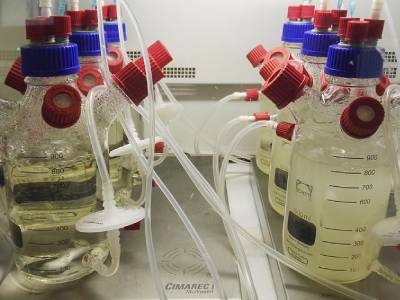
To improve stability, the researchers then introduced a sixth bioreactor into the system, which was connected to each of the other five reactors via inflow and outflow. This served as a loop and regional pool to facilitate mass transfer between the reactors, leveraging a phenomenon known as the rescue effect. This effect helps stabilize metapopulations and prevent extinction of isolated communities through migration between communities. In the bioreactors, this effect helps synchronize the bacterial metacommunity and improves the survival of slow-growing bacteria. Further flow cytometry monitoring showed that with the loop system, variation decreased and the microbiomes exhibited high constancy over long periods of time. The results of the study were published in the Proceedings of the National Academy of Sciences.
“In our study, we designed a completely new reactor system and combined a wide range of disciplines such as microbiology, ecology, biotechnology, single cell analytics, data science, and modelling,” said Susann Müller, corresponding author and head of the Flow Cytometry working group at the UFZ Department of Environmental Microbiology. “We were thus able to show for the first time that the principle of mass transfer with a loop can stabilise microbial communities in the long term. We hope that with our study we can provide stimuli for practical application.”
Mass transfers are already being used in some applications, such as in waste water treatment where part of the settling sludge from the third treatment stage is transferred back to the second treatment stage. The UFZ study can help expand this concept to facilitate more stable microbial cultivation in the lab.
Photo: The five reactors with microbial communities were operated in the same way. The sixth reactor was connected to all five reactors. It synchronised the microbial communities and fed slow-growing bacteria back into the reactors. Credit: Zishu Liu/UFZ