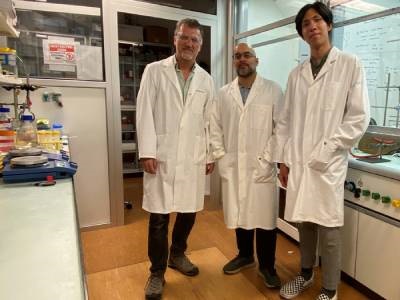
(From left to right) NTU Visiting Professor Raffaele Mezzenga from the Department of Health Science and Technology, ETH Zurich, Switzerland; Professor Ali Miserez from the School of Materials Science & Engineering and the School of Biological Sciences, NTU; and NTU PhD student Soon Wei Long from the School of Materials Science & Engineering, NTU. Credit: Nanyang Technological University, Singapore
Heavy metals in drinking water, such as lead and chromium, pose serious health risks including the risk of mutagenic diseases like cancer. Current technologies used to remove heavy metal contamination from water, such as ion-exchange, electrodialysis and membrane purification, help to ensure safety but come with drawbacks such as secondary pollution, high cost and energy-intensiveness. Researchers at Nanyang Technological University, Singapore (NTU Singapore), in collaboration with ETH Zurich, have developed a new heavy metal filtration method that is more energy efficient and uses inexpensive material derived from plant waste to extract up to 99.89% of water contamination.
To create a sustainable heavy metal filter, the team extracted proteins from oilseed meals – byproducts left over from the production of food oils like sunflower and peanut oil. The researchers then used the extracted proteins to fabricate nanoscale amyloid fibrils. These rope-like structures made from tightly-wound proteins are drawn to heavy metals and act like a molecular sieve to trap heavy metal ions as they pass by. Combining the amyloid fibrils with activated carbon, the team produced a hybrid membrane with a high surface-to-volume ratio of fibrils, making it efficient in adsorbing a large amount of heavy metals.
The researchers tested their membrane on three commonly heavy metal pollutants: platinum, chromium and lead. The team found that the membranes filtered up to 99.89% of the heavy metals, although it was most effective for lead and platinum, followed by chromium. The abundance and low cost of the protein byproducts used to produce the membranes means they can make effective water treatment methods more affordable and accessible in low-income regions, with only about 16kg of protein needed to filter the equivalent of an Olympic-sized swimming pool contaminated with 400 ppb of lead, according to the researchers. Additionally, the method to fabricate the membranes is relatively simple and scalable, and the filtration process itself requires little to no energy to filter high percentages of metal from drinking water, making it even more affordable and sustainable. This research was published in the Chemical Engineering Journal.
“With our membrane, gravity does most or all of the work,” said paper co-author Raffaele Mezzenga. “This low-power filtration method can be very useful in areas where there might be limited access to electricity and power.”
The filter could potentially be used to filter other heavy metals and pollutants beyond just lead, platinum and chromium, including organic pollutants like perfluoroalkyl and polyfluoroalkyl substances (PFAS), according to the authors. Furthermore, metals trapped in the amyloid fibril filters can be recovered and recycled. The researchers are currently exploring commercial applications of their membrane with BluAct, a water filtration spin-off company of ETH Zurich.