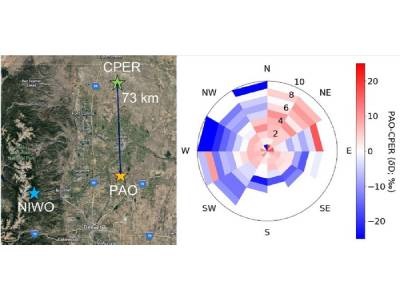
Left: Satellite image of northern Colorado Front Range with stars indicating locations of NEON CPER, NEON NIWO and PAO measurement sites. Right: Difference between PAO and CPER δD binned as a function of PAO wind speed (in m/s) and direction. Generally, δD at PAO is greater than CPER for winds from the northeast and lower than CPER for high westerly winds. Credit: Google Earth/NIST
The analysis of water isotopologue ratios in atmospheric water vapor can aid researchers in developing models for weather patterns and climate change. These analyses rely on networks of point sensors that require careful calibration to maintain accuracy over time and between sites. Now, NIST researchers have developed an open-air path spectrometer system that eases water vapor analysis in remote environments, providing precise measurements of isotopologue ratios in a little over 15 minutes.
Accurately detecting multiple water vapor isotopologues requires a mid-infrared spectrometer with high spectral resolution, high accuracy and fast measurement rates. Open-air path technologies, as opposed to point sensor networks, can eliminate the need for calibration and make it easier to capture large-scale evaporation above reservoirs or over entire watersheds. The NIST team developed an open-path mid-IR dual-comb spectrometer (DCS) system that uses near-IR femtosecond laser pulses and specially designed waveguides to create broadband mid-IR pulses in a compact package or water vapor analysis.
The team tested their new instrument by taking measurements over a 760-meter path at the Platteville Atmospheric Observatory in Colorado. They found that the instrument could operate in the field for weeks at a time without requiring intervention, allowing the researchers to acquire several months of data during a variety of weather conditions and temperatures. The measurements obtained using the DCS system correlated well with those acquired using a point sensor network, showing the potential for open-air DCS in characterizing atmospheric water vapor.
“Open-path sensing using dual frequency combs may make atmospheric water vapor isotopologue sensing simpler and easier to apply in remote environments. A broader network of isotopologue measurements will contribute to improved numerical weather modeling. The long beam paths achievable using the dual-comb technique will enable spatially resolved studies of water vapor transport over natural ecosystems as well as human-engineered ones (e.g. farms),” said researcher Daniel Herman. “Future vertical column measurements using combs might also improve calibration procedures for isotopologue measurement using satellites. In addition, sensing of water vapor with dual combs can also complement other emerging air quality applications of broadband mid-infrared spectroscopy.”
The team is now working to improve the accuracy of their technique by analyzing systematics in the detection setup, as well as improving sensitivity by using higher power combs to enable longer beam paths, said Herman. Herman is scheduled to present the team’s findings at the Optical Imaging and Applied Optics Congress on July 11, 2022 in Vancouver, British Columbia, Canada.