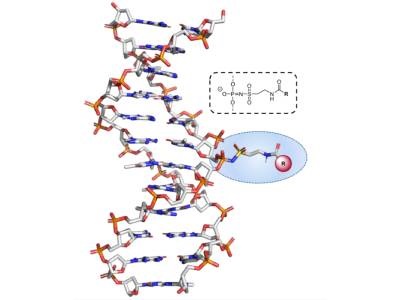
Positioning of a chemical modification in a DNA helix, which is introduced using the new and inexpensive method. Credit: Nucleic Acids Research, 2022, gkac566
Oligonucleotides are an essential resource in life sciences and medicine, enabling technologies such as gene synthesis, polymerase chain reaction (PCR) and next generation sequencing (NGS), and being a key element in novel therapies including antisense and small interfering RNA (siRNA) therapies. Traditional methods for producing oligonucleotides can be challenging and expensive, especially when special phosphoramidites are required in order to attach dyes, targeting ligands and other moieties during the synthesis process. Now, researchers at Aarhus University have introduced an easier and less expensive method for modifying oligonucleotides during solid phase synthesis, using sulfonyl azides to conjugate chemical handles and functional groups without the need for specialized phosphoramidites.
There is a growing need for highly customized oligonucleotides to meet a rising demand for novel gene therapies and diagnostic capabilities. Customized phosphoramidites are costly and unstable, susceptible to hydrolysis, oxidation and other forms of degradation. The Aarhus University team proposed the use of sulfonyl azides to modify oligonucleotides, as these compounds are relatively inexpensive and easy to synthesize, are also air and moisture stable. The team prepared 11 sulfonyl azides with different chemical handles, including amine, azide, alkyne and thiol, as well as dyes and functionalities like pyrene, photo-switchable azobenzenes and a steroid. The sulfonyl azides were applied to react with one or more selected phosphite intermediates during solid phase synthesis in order to attach the desired molecule through the Staudinger reaction.
Tests showed that the method produced good to moderate yields of the desired functional products with little change to DNA melting behavior. The method was successful in introducing functional groups such as azides and disulfides, that are difficult to incorporate into DNA using conventional methods. The process does not require laborious post-synthetic steps and is also compatible with automated oligonucleotide synthesis protocols, the authors wrote. Specifically, the method was found to work well with an automated flow-based method previously developed at Aarhus University, which both speeds up synthesis and allows on-demand production of phosphoramidites, reducing the risk of degradation. This study was published in Nucleic Acids Research.
Next steps for improving this method will include expanding the diversity of the probes and fluorophores that can be conjugated using the sulfonyl azides, the authors wrote. Because incorporation using sulfonyl azides is not restricted to terminal positioning, multiple fluorophores could potentially be added to the same strand at specific known distances without disrupting the phosphate backbone, the researchers added.