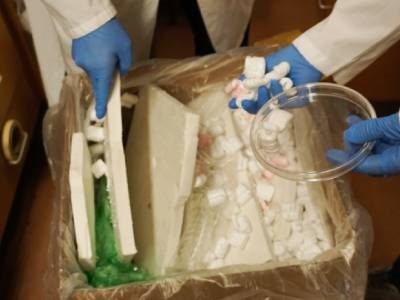
Researchers sort through various objects made from polystyrene, a type of plastic that is rarely recycled. Credit: Reilly Henson, Virginia Tech
Polystyrene is a widely-used plastic material best known for its use as a major component in Styrofoam, and is valued for its excellent thermal insulation abilities, water resistance, lightweightedness, relatively low cost and more. However, polystyrene poses challenges when it comes to recyclability, and many recycling facilities are not equipped to process polystyrene, as current methods typically yield a product that is too low-quality to make the process economically viable. Researchers from Virginia Tech have now discovered a method that makes recycling polystyrene more feasible, and more profitable, by producing diphenylmethane (DPM), a valuable chemical in multiple industries.
The researchers’ degradation-upcycling approach to processing polystyrene waste does not require expensive catalysts or a complicated procedure. The waste is first degraded using ultraviolet (UV) light, which produces aromatics that are intermediates to DPM. The team tailored cascade reactions that are catalyzed by low-cost aluminum chloride (AlCl3) at ambient temperature and atmospheric pressure, making the process relatively simple and cost-effective. Whereas current methods require high temperatures and high pressures, involve precious-metal catalysts and produce lower value products such as common aromatics, the new procedure can produce not only DPM, but also benzophenone, 1,2-diphenylethane or 4-oxo-4-phenyl-butyric acid using similar cascade strategies.
DPM is used in multiple industries including as a precursor in drug development, polymer manufacturing, fragrance production and in other consumer products. A techno-economic analysis demonstrated the economic viability of upcycling polystyrene using this method, as DPM has a market price approximately 10 times higher than other materials that can currently be made from recycling polystyrene waste. The analysis, conducted by business experts from Santa Clara University and the Dongbei University of Finance and Economics, found that the high economic value of the DPM yielded from this method would fully justify the costs of collecting and processing the polystyrene waste. This research was published in the Proceedings of the National Academy of Sciences.
“I think it’s important for people to realize that big global challenges like plastic waste can have – and most likely demand – multiple solutions,” said corresponding author Guoliang “Greg” Liu, associate professor of chemistry in the College of Science at Virginia Tech. “We at Virginia Tech can contribute a small piece to the big puzzle and offer solutions to positively impact the world.”
By showing how polystyrene upcycling can be made profitable, the researchers hope that their research will lead to less polystyrene waste being sent to landfills or becoming plastic pollution.