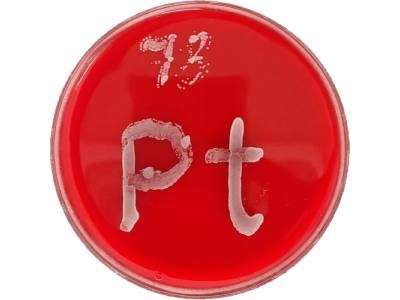
A Petri dish with red agar on which grows a fungal strand in the shape of the element symbol for platinum (Pt). Credit: CO-ADD
Fungal infections cause an estimated 1.5 million deaths per year worldwide, but very few antifungal therapeutics are currently being developed compared to other types of drugs. Many efforts to discover new antifungal drugs have focused only on organic molecules, but metal compounds have also shown potential as powerful antifungals. Despite this, the exploration of metal complexes as treatments for fungal infection has been limited due to concerns about the toxicity of these substances. Researchers from the University of Bern have now demonstrated why metals should not be overlooked as a potential solution for combating fungal infection, by leveraging crowdsourced drug discovery efforts to home in on several promising candidates.
The research team evaluated data from the Community for Open Antimicrobial Drug Discovery (CO-ADD), an initiative founded by the University of Queensland that offers chemists worldwide the opportunity to test any chemical compound against bacteria and fungi at no cost. The researchers found that 1039 of the more than 300,000 compounds tested through CO-ADD contained metals, and that 20.9% of the metal compounds tested were found to have antimicrobial activity against representative Candida and Cryptococcus strains. The team then narrowed their focus to 21 high active metal complexes and performed minimum inhibitory concentration (MIC) testing on an extended panel including eight different Candida and Cryptococcus strains. The complexes tested included metals such as cobalt, nickel, rhodium, palladium, silver, europium, iridium, platinum, molybdenum and gold.
The researchers found that most of the compounds tested showed good activity against all of the fungal strains, according to lead author Angelo Frei. The team further tested 11 of the most active compounds in an in vivo toxicity assay using Galleria mellonella larvae and discovered that only one of the compounds showed any signs of toxicity in the model organism. In vivo efficacy testing on G. mellonella larvae infected with Candida albicans identified an organo-platinum(II) cyclooctadiene complex as effective in significantly reducing infection. This study was published in JACS Au.
“Our hope is that our work will improve the reputation of metals in medical applications and motivate other research groups to further explore this large but relatively unexplored field,” said Frei. “If we exploit the full potential of the periodic table, we may be able to prevent a future where we don’t have any effective antibiotics and active agents to prevent and treat fungal infections.”