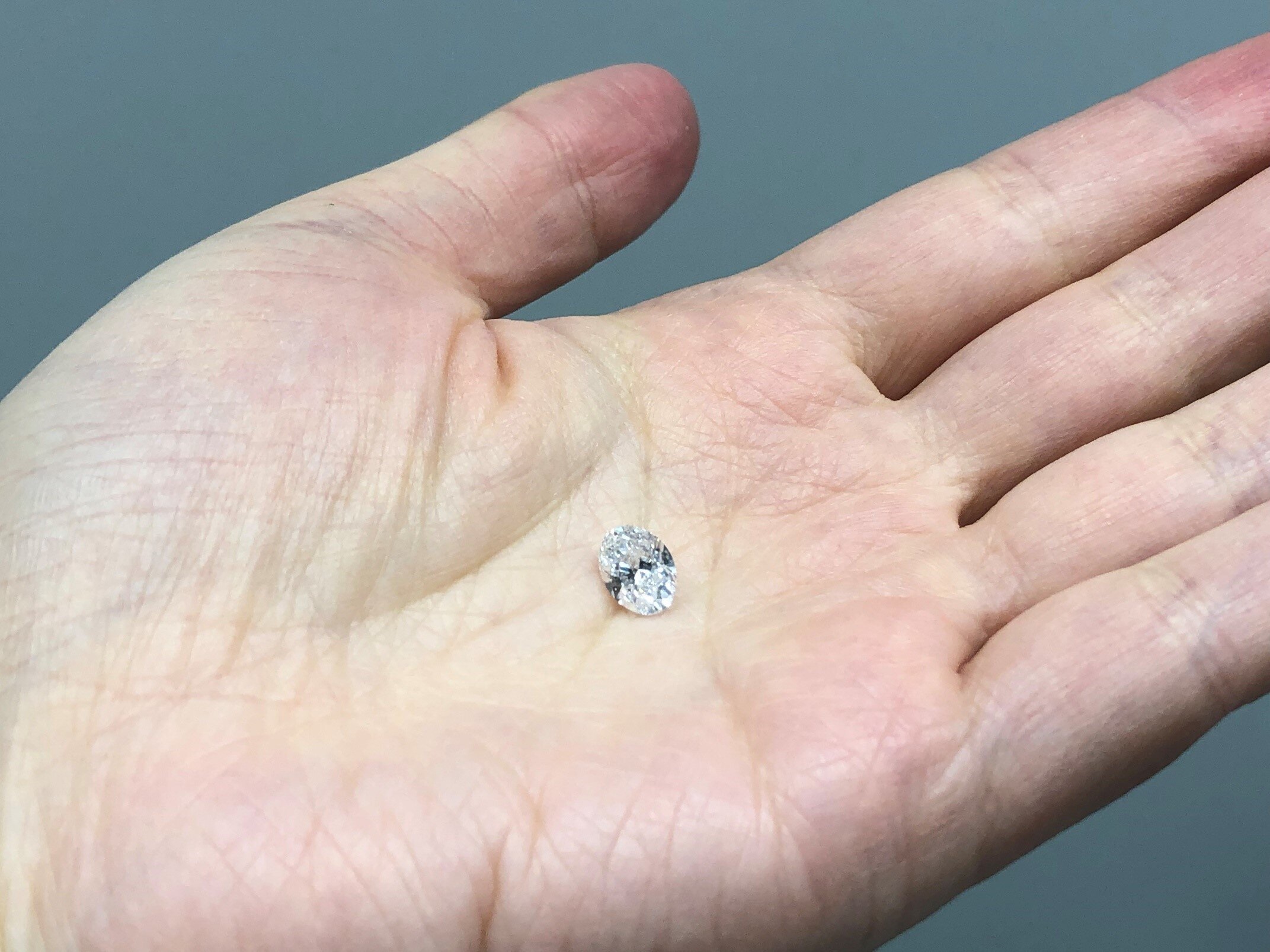
The diamond from Botswana revealed to the scientists that considerable amounts of water are stored in the rock at a depth of more than 600 kilometers. Credit: Tingting Gu, Gemological Institute of America, New York, NY, USA
The presence or absence of water in the transition zone between the Earth’s upper and lower mantle (410 km to 660 km deep) has long been a mystery that, if solved, could reveal valuable insights into the internal structure and dynamics of the planet. One theory is that ocean water accompanies subducting slabs into the transition zone, continuing the planet’s water cycle deep within Earth’s interior. Recently, an international team including German, Italian and American scientists conducted an analysis of a rare diamond retrieved from just above the Earth’s lower mantle that appears to confirm the presence of water as deep as 660 km beneath the planet’s surface.
About 70% of the Earth’s upper mantle is composed of olivine, which alters its crystalline structure under the immense pressures within the transition zone; at about 410 km, it is converted to denser wadsleyite, and past 520 km it further metamorphoses into even denser ringwoodite. Both wadsleyite and ringwoodite are capable of storing large quantities of water, but whether these minerals in the transition zone actually hold water has been unclear, said study co-author Frank Brenker, from the Institute for Geosciences at Goethe University in Frankfurt, Germany. In their study, the research team used techniques including Fourier transform infrared (FTIR) spectrometry and Raman spectroscopy to examine the chemical concentration of an extremely rare 1.5 cm IaB gem diamond from Botswana, Africa, which formed at a depth of 660 km, right at the interface between the transition zone and lower mantle.
The analysis revealed that the diamond contained numerous ringwoodite inclusions exhibiting high water content, and furthermore, the chemical composition of the stone showed it was consistent with normal mantle rock. Hydrous ringwoodite had previously been detected in a diamond from the transition zone in a study conducted in 2014, but the stone used in that study was too small to determine its precise chemical composition. Thus, the team that conducted the 2014 study could not determine if the sample was representative of the mantle in general, as the water content of that diamond could have also resulted from an exotic chemical environment. The latest study further confirms the presence of hydrous ringwoodite in the lower transition zone, supporting the theory that water from deep-sea sediments could “piggy-back” into the Earth’s interior via subducting slabs, said Brenker. This research was published in Nature Geoscience.
“In this study we have demonstrated that the transition zone is not a dry sponge, but holds considerable quantities of water,” said Brenker. “This also brings us one step closer to Jules Verne’s idea of an ocean inside the Earth.”