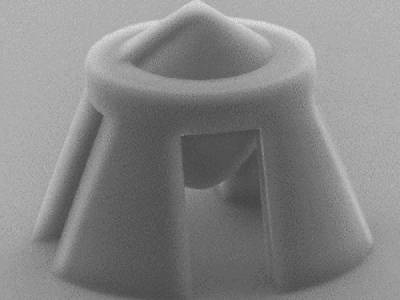
Researchers used 3D laser printing to fabricate a high-quality, complex polymer optical device directly on the end of an optical fiber. A scanning electron microscopy image of the device is shown. It includes both a parabolic lens for light collimation and a twisted axicon optic that twists the light. Credit: Shlomi Litman, Soreq Nuclear Research Center
Specialized beam shapes, such as Bessel beams, are used in a variety of applications ranging from optical tweezing to super-resolution microscopy. Such applications typically rely on bulky and costly optical elements to manipulate normal laser light – such as that propagated from a fiber laser – into the desired shape. Now, a team from the Soreq Nuclear Research Center has shown that less expensive and more compact beam shaping technology is possible, by fabricating a tiny multi-component beam shaper directly onto an optical fiber using 3D printing methods.
The researchers used 3D direct laser printing to create the Bessel beam-forming micro-optical device – a technique that uses a femtosecond laser to induce two-photon absorption in a photosensitive optical material. Only tiny volumes of the material where two-photon absorption occurs are solidified, which allows for the production of high-resolution 3D elements. The beamshaper fabricated by the researchers is made from a high optical quality photosensitive polymer and is just 110 μm tall and 60 μm in diameter. It includes both a parabolic lens for light collimation and a helical axicon lens that twists the light, transforming light exiting the optical fiber into a twisted Bessel beam. Printing the device directly onto the end of the optical fiber required the team to first perform highly accurate 2D and 3D simulations, which allowed them to determine how to best integrate the optical elements and then align them with the fiber core, said first author Shlomi Lightman.
The team built an optical measuring system to analyze the performance of the 3D printed optical device, which allowed them to capture the shaped beam propagated by the modified optical fiber. They observed very low diffraction in the beam, meaning beams produced by the device could be suitable for applications such as particle manipulation and stimulated emission depletion (STED) microscopy, a form of super-resolution microscopy that relies on Bessel beams. Additionally, they found that laser power could reach close to 10 MW/cm2 before the device was damaged, despite it being made from a polymer material, which is more susceptible to heat damage than glass. The entire device was fabricated in less than 5 minutes, and together with the fiber cost less than $100, a fraction of the cost of a standard microscope objective lens that performs a similar function, according to the researchers. This study was published in Optics Letters.
“Our fabrication method could also be used to upgrade an inexpensive lens to a higher quality smart lens by printing a smart small structure on it,” said Lightman.
The researchers are now experimenting with hybrid photosensitive materials that contain a lower percentage of polymer in the hopes of producing even higher quality optics with a longer shelf life and greater resistance to high laser powers than the original micro-optical device.