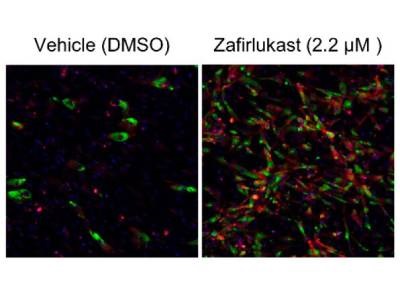
Zafirlukast induces the production of brown adipocyte tissue. For preadipocytes treated with zafirlukast (right image), brown adipocytes (shown in red) were much more prevalent than preadipocytes grown with the DMSO control (left image). Credit: Scripps Research and Calibr
Drug discovery often leverages high-throughput screening methods to test hundreds or thousands of known drug compounds for their potential to treat different diseases. However, even when a promising drug candidate is identified, issues such as the compound’s toxicity and side effects can prevent it from being approved as a viable treatment. A team from the Scripps Research Institute and the institute's drug development arm, Calibr, recently utilized a novel screening approach to identify endogenous metabolites with promising therapeutic properties, expanding opportunities to discover and develop pharmaceuticals with fewer side effects and toxicity issues.
The aim of the study was to identify compounds that could be used to promote the production of brown adipocytes (“good” fat cells that dissolve stored energy into heat) and the conversion of white adipocytes (“bad” fat cells that store excess energy) into brown adipocytes. Increasing the number of brown fat cells is a potential approach to managing obesity and associated metabolic diseases like type 2 diabetes and arteriosclerosis. The researchers first used high-content imaging to screen Calibr’s ReFRAME drug-repurposing collection – a library of 14,000 known drug compounds that have been approved by the FDA for other diseases or extensively tested for human safety – to identify a compound that could promote brown adipocyte production in human Simpson-Golabi-Behmel Syndrome (SGBS) preadipocytes. The high-throughput screening identified the asthma drug zafirlukast as a potential candidate, but this compound is toxic when administered at high doses.
In order to understand the metabolic processes through which zafirlukast promotes conversion of preadipocytes and white adipocytes into brown adipocytes, the team developed a novel drug-initiated activity metabolomics (DIAM) screening platform. This involved untargeted liquid chromatography-mass spectrometry (LC-MS) analysis of metabolites from zafirlukast-treated cells alongside controls, allowing the researchers to narrow down more than 30,000 initial annotated metabolic features to 17 metabolites that showed changes following zafirlukast treatment. Further testing of these 17 metabolites revealed that one endogenous metabolite – myristoylglycine – prompted production of brown adipocytes without causing any damage to cells. This suggests that the non-toxic, naturally occurring metabolite could potentially be used as a treatment instead of the toxic zafirlukast. This study was published in the journal Metabolites.
“The reason many types of molecules don’t go to market is because of toxicity. With our technology, we can pull out endogenous metabolites–meaning the ones that the body makes on its own–that can have the same impact as a drug with less side effects,” said co-senior author Gary Siuzdak, the senior director of the Scripps Center for Metabolomics and professor of Chemistry, Molecular and Computational Biology at Scripps Research. “The potential of this approach is even evidenced by the FDA’s recent approval of Relyvrio, the combination of two endogenous metabolites for the treatment of amyotrophic lateral sclerosis (ALS).”